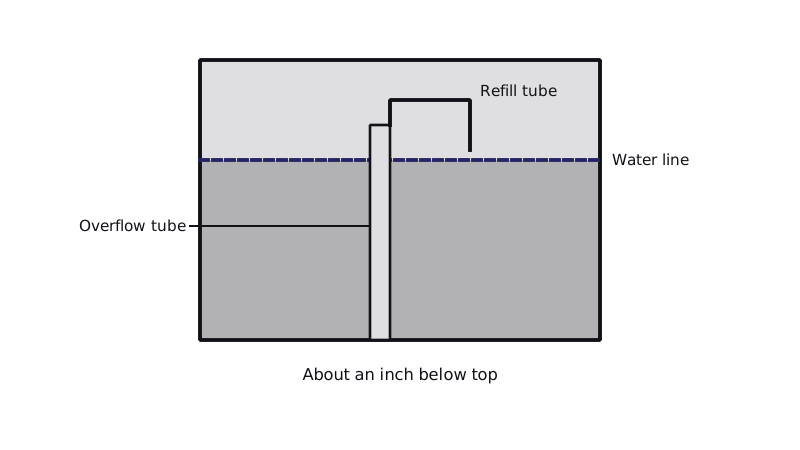
Inside the tank, the overflow tube stands upright in the middle with its open top a little under the lid. It works as a safety drain: if the fill valve fails, water goes down the tube instead of onto your floor. A steady trickle tells you the tank water is higher than the tube's top. Start at the toilet repair page for the wider set of toilet jobs.
What makes water flow down the overflow tube?
Nearly always, either the float is set too high or the fill valve never shuts. Once water climbs to the tube's opening, the excess pours in and heads to the bowl, so the valve refills over and over. The cure is a lower level or a new fill valve; the tube itself needs no attention.
Lift off the lid and have a look. Normal water stands about an inch below the tube's opening, or at the fill mark on the tank wall. If it touches or passes the rim, adjust the float. If it will not stop at any setting, the valve is worn, and hard water can leave scale that stops the seal closing.
A small hose, the refill tube, clips onto the upper end of the overflow tube. Its end should sit above the water line, not below it. A hose hanging under the surface can siphon water back into the tube.
Can you replace a flush valve yourself?
Many homeowners do. The steps run like this: turn off the supply, drain the tank, unhook the supply line, undo the tank bolts, lift off the tank, unscrew the nut holding the old flush valve, install the new valve, replace the gasket and bolts, and reseat the tank. It takes patience and a gentle hand, since porcelain cracks under force. Replace rubber parts at the same time.
Be honest about your limits. A plumber can save the toilet when the tank bolts are corroded, the tank is stuck, the toilet wobbles or the bowl has a crack. An old toilet with several faults may be cheaper to swap out than to fix; read about replacing a toilet.
In tight bathrooms, drain air from the supply line by opening the fill valve briefly with the tank off, so you are not blasted with a spurt when it restarts. Reopen the water slowly, then inspect each joint for drips.
When is it time to bring in a plumber, and what happens at the visit?
Phone someone if the tank is cracked, the water will not stop at any setting, the shutoff valve is stuck open, water collects around the bowl base, or you are unsure how to lift off the tank. The plumber can fit a new valve and tube, test the shutoff and try the flush. Our site does not do the plumbing; we pass your request to a local plumbing business, which pays us a fee for it.
Open the quote page and say what the toilet is doing, its age and whether it has one piece or two. Photos of the inside of the tank help. Other jobs we can arrange are listed on the home page.
A repair's price depends on parts, access and the trip charge, and no price is printed here. Hard Temecula water, with Rancho Water's reports putting average hardness around 230 to 240 mg/L in the 2020 to 2023 editions, shortens the life of rubber parts and valve seals, so replace worn parts rather than patching.
How do you adjust the water level?
Turn the adjustment screw on the fill valve, or slide the float clip or cup down the rod on a cup-style valve, until the level settles roughly an inch lower than the tube's rim. Flush, let the tank refill, and check again. On older ballcock valves, you bend the float arm slightly. Change one thing at a time.
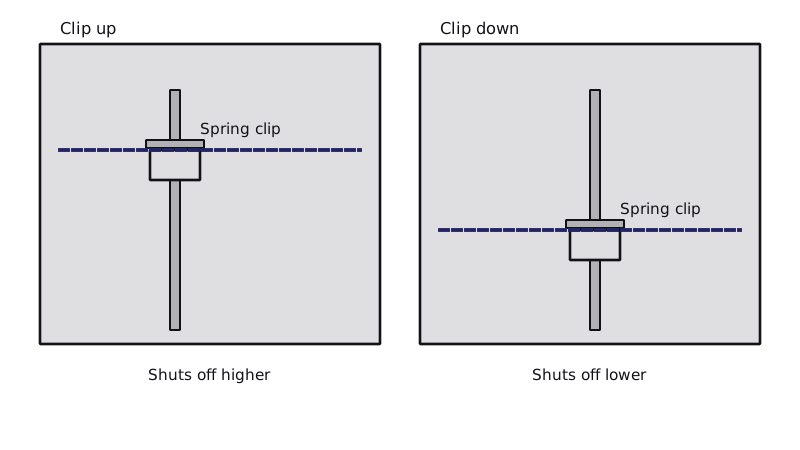
Mind the brand. Fill valves look different, and some use a screw at the top, others a clip, others a twist collar. If you cannot find the adjustment, look up the model printed on the valve or the toilet's tank.
Before taking anything apart, close the wall supply valve and flush until the tank is empty. The guide to fill valve repair covers a swap step by step.
What if the tube is cracked or leaking?
Tank water can seep into the bowl even at the right level if the tube is split, or cracked where it meets the flush valve. Since the tube normally forms part of the flush valve assembly, fixing it means a new flush valve, and that job means lifting the tank off the bowl.
To check, look for a hairline split, or dry the tube and watch for damp spots or staining. For a silent leak the EPA suggests adding several drops of food coloring to the tank; if the bowl shows color within about ten minutes with no flush, the tank is leaking, and the flapper is the likelier cause. Flush soon after so the tank is not stained by the dye.
Seen from the bowl side, a flapper failing to seal looks the same as an overflow problem, so check both. The page on flapper repair explains how.
Common questions
Is a running toilet wasting much water?
It can waste a lot. According to the EPA, a typical home wastes upwards of 9,300 gallons a year through leaks, and a worn flapper or high water level often accounts for part of it. A running toilet can noticeably raise a water bill, so fix it sooner rather than later.
How can I tell the tube from the flapper as the cause?
Look at the level first. If water stands above the tube's top, the tube is carrying the excess. With a correct level and a tank that still empties slowly, suspect the flapper. Tint the tank water with food coloring to see whether any passes into the bowl.
Can I shorten or lengthen an overflow tube?
Some flush valves have an adjustable height, and a tube can sometimes be cut to a new height using the maker's instructions. Do not cut one without checking, because the height matters for the flush and for safe overflow. If in doubt, replace the whole valve assembly with the matching model.
Why does my toilet tank keep filling after I flush?
The cause may be a slow leak at the flapper, a worn or dirty fill valve, or water spilling into the tube. Air in the line can also cause a hissing sound. Close the supply valve, check the level, and test each part one after another.
Updated