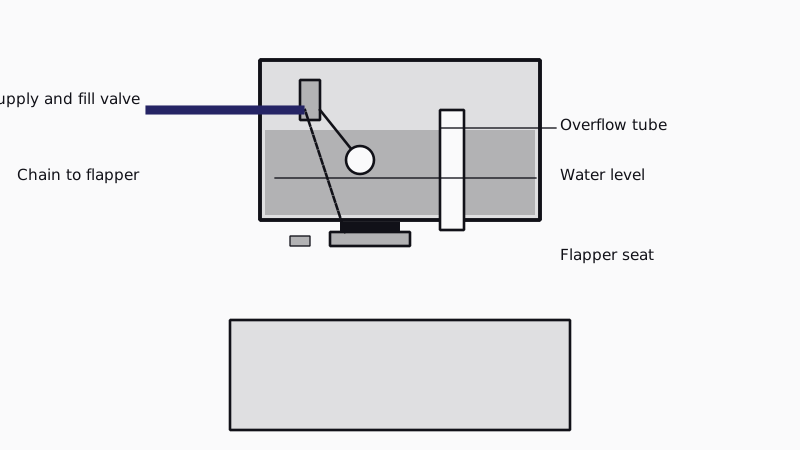
When a toilet keeps running once the flush ends, the tank either fails to seal or fails to shut off. Lift the lid and look: nearly every case comes down to a chain trapped under the flapper, a flapper that sits badly, a float set too far up or a tired fill valve. This guide sits under our toilet repair help and starts with what you can safely check.
Why does water keep moving after the toilet has flushed?
Either water keeps entering the tank or it keeps escaping. If the flapper fails to close, water seeps into the bowl and the tank fills again and again. If the fill valve never stops, water climbs into the overflow tube and drains down it. In both cases the cycle never finishes, and listening will usually show which of the two applies.
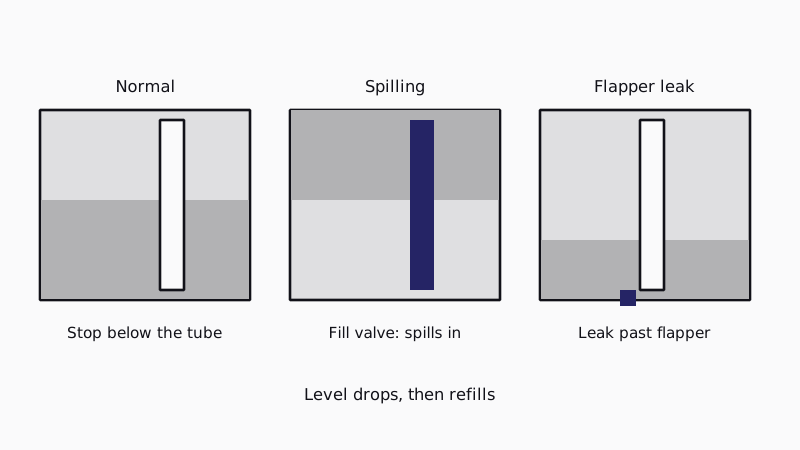
A short test works well. Lift the lid, flush, and see whether the flapper drops and lies flat over the hole. Next, follow the water level. A level that stops short of the top of the overflow tube, with the noise ending, is healthy. A level that rises to the tube and spills over points to the fill valve or float. A level that never recovers while the noise goes on means the flapper is leaking.
A table makes the matching easy.
| What you see or hear | Likely cause | First thing to try |
|---|---|---|
| Water trickling into the bowl, tank never full | Flapper not sealing | Wipe flapper and seat, adjust chain |
| Tank full, water spilling down overflow tube | Float set too high or fill valve not shutting | Lower the float, then replace valve |
| Hissing for a long time after the flush | Fill valve worn or debris inside | Flush supply line, replace valve |
| Handle sticks down | Handle or lift arm binding | Free the arm, replace handle |
| Phantom refills every few minutes | Slow flapper leak | Dye test, replace flapper |
What counts as too long for a toilet to keep running?
Refilling for about a minute or less, then falling silent, is normal. If yours runs for several minutes, never stops, or starts up on its own, something is wrong. A valve that closes late may reflect low supply flow, which is slow but harmless, or a valve that does not seal, which is not. Time it once, then decide.
Check the supply valve before you assume a fault. A supply stop that is half closed makes a tank fill slowly, and a sluggish fill can look like a running toilet. Open the valve fully and listen again. If you hear a high whine, pressure may be high; see water pressure regulator adjustment.
A toilet that runs for a minute and stops is not the same as one that sounds like it is flushing every ten or twenty minutes. The second is a slow leak out of the tank, and it is the one that wastes water. By the EPA's figures, the average household loses more than 9,300 gallons yearly to leaks, and toilets are a common source. To confirm one at the meter, follow what drives a high water bill.
Which fixes can I do on my own?
Begin with the cheap fixes that need no parts: free the chain if it is caught under the flapper, tune it to give roughly 1/2 inch of play, drop the float or turn the valve's adjustment screw, wipe the flapper edge and seat with a cloth, and make sure the handle returns fully. These take minutes and often cure it. Always close the supply if you need to disconnect anything.
If those do not work, replace the flapper, which is cheap, then the fill valve. The fill valve swap is walked through in replacing a toilet fill valve, and the page about flapper repair covers choosing the right type. For a longer list of causes, see how to fix a toilet that keeps running.
Local water hardness plays a role in Temecula. Rancho California Water District's own reports put average hardness around 230 to 240 mg/L, roughly 13 to 14 grains per gallon, in the 2020 to 2023 reports. That is very hard water. Scale on the flapper seat is a frequent reason a good flapper still leaks, so run a cloth or a plastic scrubber over the seat before you replace anything. Check the current report at ranchowater.com.
When should you hand a running toilet to a plumber?
Pick up the phone when the flapper and fill valve are new and the toilet still runs, when the shutoff valve drips or refuses to close, when water seeps around the base or bolts, when the tank has cracked, or when you cannot get at the fault. If the toilet runs and its own supply will not shut off, shut the main valve for the house, then call.
Whether pressure contributes, and whether the toilet merits repair, are also questions a plumber can answer. Older toilets in Old Town, and in Rancho California homes from the 1970s through the 1990s, may use more water per flush, and decades-old fittings can snap at a touch, so go gently. If a visit seems right, request a quote and list the checks above that you did; a local plumbing business will then contact you.
Water on the floor is more urgent than noise. Mop it up and watch for a damp subfloor, a stained ceiling beneath, or a soft spot. Do not use electrical items near water, and turn off the supply while you wait.
Common questions
Why does my toilet run for a few seconds every ten minutes?
That is called ghost flushing or phantom flushing. Tank water seeps into the bowl, typically around a worn flapper or dirty seat, and once the level drops far enough the fill valve starts up to top the tank off. Run the dye test, clean the seat, and fit a new flapper if the water in the bowl takes on color.
Is jiggling the handle an acceptable habit?
Jiggling quiets it for the moment, yet it shows that something is not seating, most often the chain, flapper or handle arm. The leak behind it keeps wasting water. Fix the cause within days, and note that a handle needing a jiggle on every flush will wear out faster, so replace the part rather than the habit.
Must someone be home when a plumber repairs a running toilet?
Yes, either you or a trusted adult. The plumber needs to reach the bathroom and the shutoff, and you should watch the work and settle the price before it starts. A toilet fix is short, so you can usually book a window and be present for it, and ask for the old parts if you want to see them.
What should I ask first when I hire someone for a running toilet?
Check whether the call fee is included, whether the quote covers the flapper, fill valve and supply line, and whether they will fix the cause or just stop the noise. Also ask whether they will check the shutoff valve while there. A short list of small jobs is cheaper to do in one visit than in several.
This guide is one of many on Temecula Pipe and Repair.
Updated