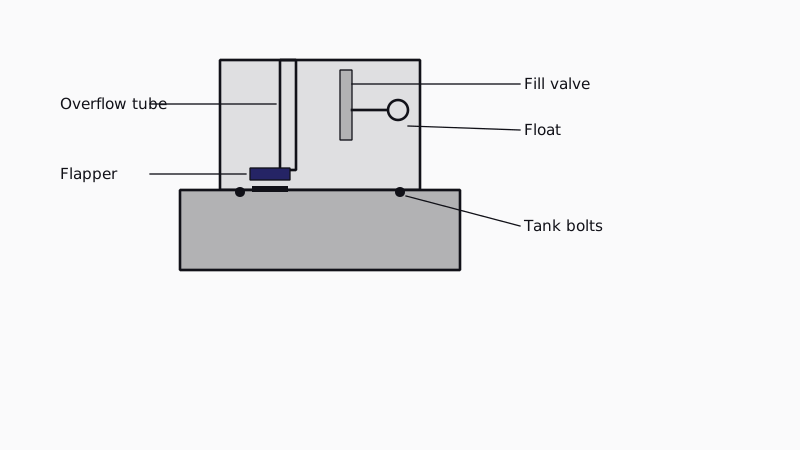
A leaking tank is usually a cheap repair on a toilet that is otherwise sound. Water escapes at the bolts holding the tank to the bowl, at the big rubber seal where the tank outlet meets the bowl, around the fill valve's nut, or through a hairline crack in the porcelain. Condensation can imitate all of these. If the job feels beyond you, the toilet repair page explains how a plumber is arranged through the quote form.
Always start the same way: dry the tank and floor completely, then run a dry paper towel along every joint to find the one that gets wet.
Is the tank really leaking, or is it sweating?
A sweating tank has a wet outside surface all over, while a leak produces drops at a particular point, usually below the tank or at a bolt. Warm, humid air touching the cold tank leaves moisture beads on the porcelain. It is normal in damp weather and does not mean any part has failed.
Wipe the tank dry, wait, and check where the first bead forms. If the entire surface beads at once, it is condensation. If a single spot weeps, it is a leak. In a mostly dry inland climate heavy sweating is less usual, though a long shower can raise bathroom humidity enough to cause it. Insulated tank liners or an anti-sweat valve fix true condensation.
Why is water dripping from the tank bolts?
The two bolts through the tank bottom each carry a rubber washer, and when that washer hardens or the nut loosens, water creeps along the bolt and drips below. A single quarter turn on a loose nut sometimes fixes it. If tightening does not help, the washer needs replacing.
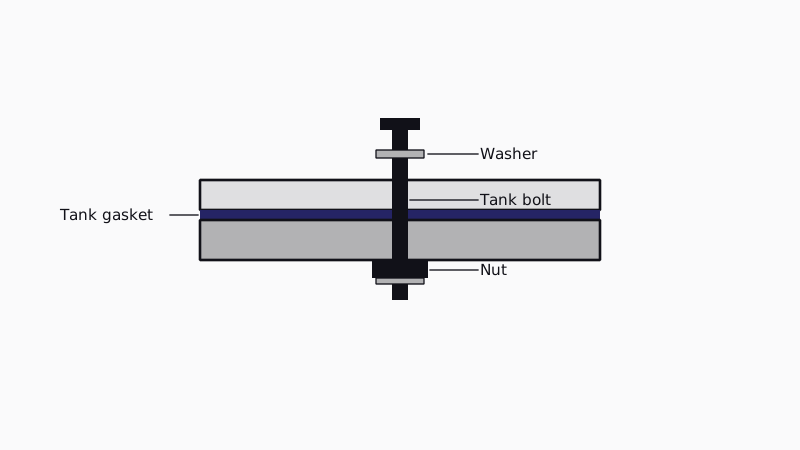
Keep the bolt head still inside the tank using a screwdriver as you turn the nut below, and stop as soon as it is snug. Porcelain cracks if you force it. For a stubborn corroded bolt, replacement is the cleaner path. Rust flakes from old bolts staining the bowl are another sign it is time. Replacement kits are widely sold and cost little, but you need a dry tank to fit them.
How do you replace the tank gasket or bolt washers?
Close the shutoff valve, flush the tank empty and soak up the rest with a sponge. Disconnect the supply line, undo the two nuts under the tank, lift the tank off, replace the rubber seal and the bolt washers, then seat the tank so the seal sits evenly. Tighten the nuts alternately in small steps and reconnect the water.
Check the numbered steps in the order you do them: 1) shut water and drain, 2) disconnect supply, 3) remove the nuts, 4) lift off the tank with two hands, 5) fit the new parts, 6) reseat and tighten evenly, 7) refill and watch for a bead. A tank is heavier than it looks, so get help if you cannot lift it comfortably. If the porcelain chips or the bowl outlet is damaged, stop and call a plumber.
Could the fill valve or the overflow seal be leaking?
Yes. A fill valve that leaks at the nut under the tank drips onto the floor and is sometimes mistaken for a tank crack. A worn flush valve seal can also let water seep into the bowl, which looks like a running toilet, not a puddle. The fill valve is a replaceable part on most toilets.
If the tank refills without end or you hear hissing, the valve may be worn or the float misadjusted; the guide on fixing a toilet fill valve gives the steps. A bowl that refills by itself with no puddle is a flapper issue, covered in toilet flapper repair. Where water is hard, as in Rancho California Water District's service area, with reports showing average hardness near 230 to 240 mg/L in the 2020 to 2023 reports, scale can shorten the life of rubber seats and seals.
Does a cracked tank mean replacing the toilet?
A cracked tank must be replaced, and a hairline crack that weeps cannot be repaired lastingly with sealant or epoxy. If the crack is in the tank and the bowl is sound, a matching tank can sometimes be bought, but fit and finish vary. Many owners choose a new toilet instead.
Check the crack by drying it and watching the line. Do not run a cracked tank for long, since it can fail suddenly and flood the floor. The cost of swapping a toilet is on the page for replacing a toilet, and you should compare that with the repair before deciding.
When is a plumber the right call?
Hire one if the leak is below the bowl rather than at the tank, the bolts are seized, the porcelain is cracked, the water cannot be isolated, or your attempts made the leak worse. In one visit a plumber swaps parts, tests the toilet and looks for floor damage.
According to the EPA, leaks waste more than 9,300 gallons of water per typical household each year, so even a small tank weep deserves a fix. Get the price before work begins; the plumber prices page explains how call-out charges and hourly rates work. The related guide on plumbers and toilet leaks goes through leaks at the base and the supply line.
Common questions
Why does a toilet tank leak from the bottom?
Typical causes are worn tank bolt washers, a degraded rubber gasket between tank and bowl, or a leaking fill valve nut. Dry the area and find the first drop. A cracked tank can leak from the bottom as well. Parts are inexpensive, and a plumber can do the swap quickly.
Will silicone repair a leaking toilet tank?
Silicone does not hold against water pressure and moving parts, and it can trap moisture and hide a worsening leak. The reliable repair is a new gasket, washers or valve. Silicone can seal a tank liner or lid only for minor cosmetic reasons, not for a leak.
How do I stop my toilet tank from sweating?
Raise the air flow in the bathroom with a fan, reduce shower humidity, or fit a foam tank liner. Some owners install an anti-sweat valve that mixes a little warm water in. None of these fix a leak, so confirm the water is condensation first.
Is a leaking toilet tank urgent?
A steady drip can be handled in a day or two if you shut the supply when away and catch the water. A spray, a crack or a leak that soaks flooring is urgent. Start a request from the home page.
Updated