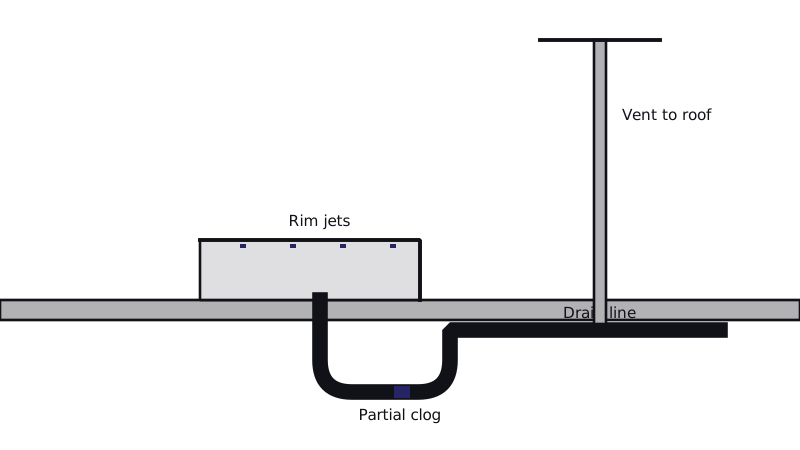
Flush once and watch. A bowl that swirls weakly, or water that rises before it drops, means a slow flush, usually from a half-blocked drain, scaled rim jets or a tank that holds too little water. If the flush is strong but the tank takes minutes to refill, the fill side is at fault. For wider toilet jobs, see the toilet repair page.
Why does my toilet flush slowly?
A feeble flush has four usual sources: a partly blocked trap, rim jets plugged under the bowl lip, too little water in the tank, or a flapper that shuts early. A blocked plumbing vent can also slow the flush, since the drain pulls water along only when air can get in behind it.
Test the easy things first. Take the lid off and check that the water sits at the fill line. Then raise the flapper chain slightly to see whether holding the flapper open longer gives a stronger flush. If it does, the chain length or the flapper is the problem, and the fix is an adjustment, not a part.
Mineral deposits are another cause. In this valley Rancho Water's reports put average hardness around 230 to 240 mg/L, roughly 13 to 14 grains per gallon, in the 2020 to 2023 reports, and hard water leaves scale in the rim holes. The flush loses force because the water cannot leave the tank and bowl rim fast enough.
If a flush gurgles, or nearby drains bubble when the toilet flushes, the vent or the drain line is the likelier culprit rather than the toilet, so a plumber should inspect it.
How do I clear a partial clog?
Take a flange plunger, the type with a rubber flap that fits the toilet outlet, and add water until the cup is covered. Start with gentle presses that expel trapped air, then work it firmly in and out for roughly thirty seconds. If the water drains and the flush is strong again, you are done.
A partial clog flushes slowly but does not overflow, so it is easy to ignore until it blocks fully. Do not use chemical cleaners. They can splash, damage fittings, and they are dangerous if you then need to plunge or auger.
If plunging fails, try a closet auger, a short toilet snake that passes through the trap. Guide it in slowly using the crank, rotate it to break up or snag the obstruction, then draw it out. Cover the floor with towels first.
Flushed items such as wipes sold as flushable, toys, hygiene products or too much paper are the usual blockage. Older homes can have older drain lines and rougher pipe where such things catch, so a repeat clog may mean the line needs a camera check.
How do I clean blocked rim jets?
Rim jets are small holes under the lip of the bowl where tank water enters. Mineral scale narrows them. Pour a household acidic cleaner, such as white vinegar, into the overflow tube, let it sit, then scour the holes using a small brush or straightened wire before flushing.
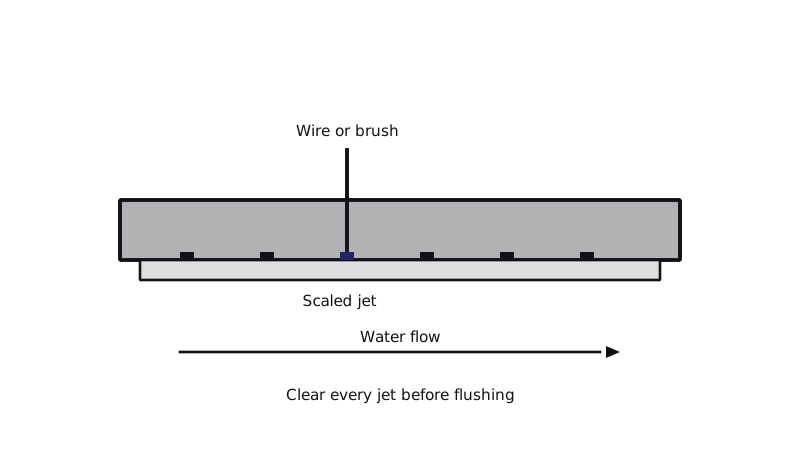
Do this with the tank water level normal and the supply on. Be careful with products: never mix vinegar with bleach or any other cleaner, because the mixture can give off harmful fumes. Wear gloves and rinse well.
Use a hand mirror to look under the rim and see which holes are blocked. A paper clip or small drill bit by hand can open them. Do not force a drill bit into porcelain, and go slowly.
Scale that returns fast may reflect hard water; regular cleaning, or a water softener, can help. If that is the root issue, softeners are covered elsewhere on the site.
Why does my toilet tank fill slowly?
A slow refill comes from a partly closed shutoff valve, a clogged fill valve, low supply pressure or a kinked supply line. Check the valve on the wall by opening it fully, then take the cap off the fill valve and flush debris from the inlet with the water on briefly under a cup.
Grit tends to turn up after plumbing work, or once the city or district has flushed its mains, and it can lodge in the valve. Shut the supply, remove the top of the fill valve per the maker's instructions, turn the supply on briefly into a cup to flush it, then reassemble.
If the fill valve is old and the water comes in as a trickle, replace it. A new valve is an inexpensive part. Match the type to your tank, and if you feel unsure about shutting water off, replacing a supply line or working under the tank, call a plumber.
Low pressure at every fixture is a different problem. Check other taps in the house. A pressure regulator or a main line issue would show up elsewhere, and the cause may not be the toilet at all. When the toilet alone is sluggish, the fault is local.
Is the toilet really running slowly, or is it running when it should not?
A toilet that hisses or trickles with no flush is a running toilet, not a slow one. The cause is either a leaking flapper or a fill valve stuck open. The cure is different, and the full guide on stopping a toilet that keeps running covers it.
A fast way to separate them is to add a few drops of dye to the tank and wait. If color reaches the bowl with no flush, it is a leak rather than a slow fill. A toilet that is both slow and running has two problems, so cure the running first.
Running toilets affect the water bill far more than slow ones, so if your meter still turns while everything is off, address that first. The plumber can diagnose the fault and quote it. Book a visit through the quote form. Other work we arrange is shown on the home page.
Common questions
Why does the bowl rise before it empties?
The drain is partly blocked, so water cannot leave as fast as it enters. Try a flange plunger. If it still happens, a closet auger may be needed, and a blockage that keeps coming back means bringing in a plumber, possibly for a camera inspection of the line.
Can low water in the tank cause a weak flush?
Yes. Less water means less force. Check that the level reaches the fill line and adjust the fill valve or float if not. Also check the flapper chain for slack, since a chain that is overly long or tangled can cut the flush short.
Is a slow flush a plumber call?
Frequently not. A plunger, vinegar on the rim jets and a fill valve check solve most cases. Call a plumber if the problem returns, other drains gurgle, you suspect a vent or main line issue, or you cannot shut off the supply to the toilet.
Will a drain cleaner fix a slow toilet?
It is not recommended. Chemicals can damage fittings, splash onto skin and eyes, and leave behind a danger for anyone who must plunge or auger the toilet afterward. A flange plunger or a closet auger is safer, and a plumber's tools handle what those cannot.
Could the slow toilet be a vent problem?
Possibly, if the flush gurgles or other drains bubble. Air enters the drain system through the vent pipe. A blocked one, from a bird nest or debris on the roof, slows drainage. Roof work is a plumber's job, so do not climb up yourself.
Sources used
Updated