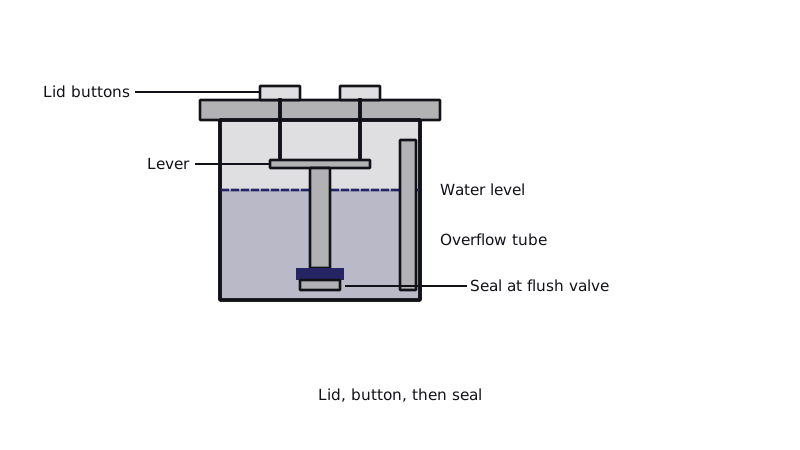
A dual flush toilet has a different heart from the classic flapper-and-chain tank. A push button or a two-way lever on the tank lifts a flush valve, which releases less water for liquid waste and more for solid waste. If that valve fails to close all the way, water seeps through into the bowl and the tank is refilled again and again by the fill valve. You end up with a hiss or trickle that never ends. The toilet-wide overview is on the toilet repair page.
Glacier Bay is a retail toilet brand, and its tanks may come in several designs over the years. Parts differ by model, so use the model number inside the tank or on the box as the reference when you buy anything. The steps here apply to most dual flush tanks.
Is the lid or the button holding the valve open?
Start at the top. On many dual flush toilets the buttons sit on the lid and press down on rods or a lever inside the tank. A lid sitting slightly off its seat, or a sticking button, can hold the flush valve partly lifted, so water runs into the bowl until the lid is reseated or the button freed.
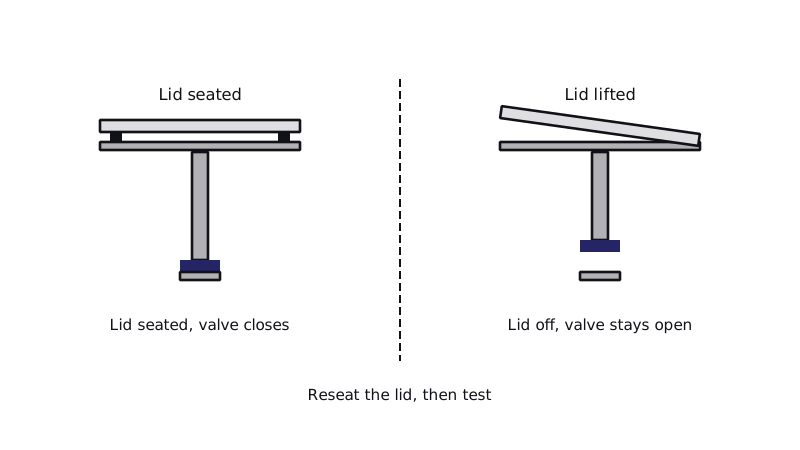
Take the lid off and watch: if the running stops, the lid or button was the culprit. Check that the lid sits flat on its pads, that each button springs back fully and that the rods do not rub on the tank wall. A button that does not rise after pressing may be dirty. A light cleaning and a drop of silicone grease on a plastic stem, not oil, often frees it.
Could the flush valve seal be dirty or worn?
Yes, and once the lid is ruled out it is the most frequent cause. The seal is a rubber ring or flap at the tank outlet, and scale, grit or age can stop it closing tight. You can often see a gap or a thin stream slipping past, and a dye test settles it.
Add some food coloring to the tank water, leave the toilet unflushed for ten minutes and look in the bowl. Tinted water there points to a leaking seal. Close the supply valve, empty the tank by flushing, and wipe the seat and seal with your fingers or a soft pad. In an area with very hard water, like Temecula, where Rancho California Water District's reports show average hardness near 230 to 240 mg/L in the 2020 to 2023 reports, scale builds up on both. A cleaned seal sometimes works. A worn or warped one needs replacement.
Could the water level be too high?
If the water rises past the overflow tube it pours down the tube nonstop, so the fill valve never rests. The correct line sits about an inch below the tube's top, and the fill valve should shut off there with a firm click.
When the tube is spilling, lower the fill valve's float with its adjustment screw or by sliding the clip. A fill valve that hisses, leaks or refuses to shut off may need replacing, and the guide to fixing a toilet fill valve explains the steps. Some dual flush designs use a tower-style fill valve, and the same level rules apply.
How do you replace a dual flush valve or its seal?
Shut the shutoff and flush the tank empty. Disconnect the buttons or rods, remove the supply line, undo the nuts beneath the tank, lift the tank off and fit the matching kit for your model in place of the flush valve or seal. Put it all back, refill and watch for leaks.
Because this means lifting the tank and replacing a part sealed with a large rubber gasket, it is a bigger job than adjusting a chain. Check the model number first, then compare the kit's description with what you see. If the kit does not match or the porcelain is chipped, stop. Tank gasket and bolt details are covered in leaky toilet tank repair.
Is it the actuator, cable or chain slack?
Some Glacier Bay-style tanks use a cable or chain from the button mechanism to the valve. If the slack is too short, it can keep the valve a little open. Adjust until a small amount of play exists, around half an inch, as with a regular flapper chain.
If your tank has a standard chain, the related guide on flapper chain replacement covers the measurements. For a regular-flapper toilet that keeps running, toilet running when not in use lists the broader causes. If the tank hisses or gurgles as it refills, see a toilet that sounds like it is running.
When is a new toilet or a plumber the right answer?
Call a plumber when no kit fits the parts, the tank is cracked, the valve seat is damaged, or you would sooner not lift the tank yourself. Weigh replacement if the toilet has already needed several repairs. A plumber can bring parts, install them and test the flush during a single visit.
By the EPA's count, the average household wastes more than 9,300 gallons annually through leaks, and a constantly running toilet adds to the total. WaterSense figures show water-saving replacements can save a family about 13,000 gallons a year, though that number applies to swapping out old, inefficient toilets. Prices are in replacing a toilet. Send a request through the quote form.
Common questions
What makes a dual flush toilet run on after a flush?
Usual reasons are a seal that does not close fully, a stuck button or rod, a lid sitting off its pads or a high water level. Take the lid off and see whether the running stops. Then clean the seal and check the float. Replace a worn part with the kit for your model.
Where do I find the model number for parts?
Look inside the tank, on the back of the tank lid, on a sticker or molded into the porcelain, and on the original box. A photo of the inside of the tank with the lid off helps a plumber or parts counter match the right kit.
Can I keep using a toilet that runs on?
It will work, but it wastes water and the fill valve can wear faster. Close the shutoff if you will be away. The silent version of the leak is harder to spot, so the dye test is worth doing. The wider guide on running toilet fixes has more.
Does a dual flush toilet need special plumbing?
No. It connects to the same supply line and drain as any toilet, and the dual flush action lives inside the tank. The rough-in distance and flange fit are the same checks as for other models. Return to the home page for other services we arrange.
Updated