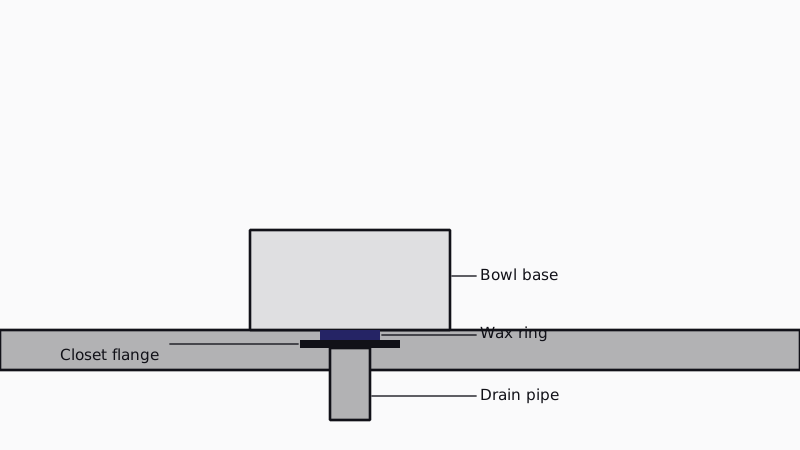
Dry the toilet and the floor thoroughly. Next press a dry paper towel against each joint in turn and note which spot darkens first. A leaking supply line needs only a wrench, and leaking tank bolts need new washers. A leak at the base usually traces to the wax ring, so the toilet must come up. A cracked bowl means replacing the toilet. Neighboring faults are covered in the wider set of toilet repair pages.
How can I tell where my toilet is leaking from?
Puddles at the foot of the toilet most often come from the wax ring, though the supply line, the shut-off valve, the tank bolts, a sweating tank or a cracked bowl may be responsible. Dry everything, place dry tissue around the base and watch for the first wet spot.
Go through the possible sources, simplest first.
- Supply line and shut-off valve. Inspect where the braided line joins the valve and the fill valve. A weeping nut is the easy case: tighten by hand and add a small turn, or replace the line.
- Tank-to-bowl bolts. Water at the back of the bowl under the tank usually means worn rubber washers on the bolts. Replace the washers and bolts.
- Condensation. A chilly tank sitting in a warm room sweats, and drops trickle down the bowl. That is not a leak. Wipe it dry and check whether moisture returns on a dry day.
- The base. Water that shows up only after a flush, or that has a sewer smell, points to the wax ring or a loose closet bolt.
- The bowl itself. A hairline crack in the porcelain leaks after filling. A cracked bowl cannot be repaired reliably.
How do I repair a toilet that leaks around its base?
Turn off the supply, flush until both tank and bowl are empty, disconnect the supply line and lift the toilet off its closet bolts. Remove the old wax, check the flange for cracks, fit either a new wax ring or a waxless seal, set the toilet straight down and tighten the nuts evenly, switching sides as you go.
Two people often are needed, since a toilet is heavy and porcelain chips easily. In more detail:
- Turn the valve clockwise to shut the water, flush, then sponge out what remains. Disconnect the line.
- Pop the caps, remove the nuts on the closet bolts and rock the toilet gently to break the seal. Lift straight up and set it on a towel or cardboard.
- Stuff a rag into the drain opening to block sewer gas. Scrape off the old wax and look at the flange. It should sit level with or just above the finished floor, with no cracks or rot around it.
- Fit the new wax ring, bolts in place, then lower the toilet straight down so the ring seals first time. Do not rock it once it is seated.
- Tighten the nuts by hand in small increments, alternating left and right, until the toilet feels firm. Too much force cracks the base.
- Reconnect the supply, open the valve, let the tank fill, then flush several times and look for water at the base.
If the toilet rocks after you set it, do not just tighten harder. A rocking toilet needs shims or a leveled flange, or the new ring will fail again.
How do I deal with a cracked flange or a spongy floor?
A broken flange, or a floor that sags when pressed near the toilet, shows the leak has persisted for some time. A flange repair ring can fix a cracked flange when the pipe below is sound. A soft or dark subfloor means rot, and that is a bigger repair.
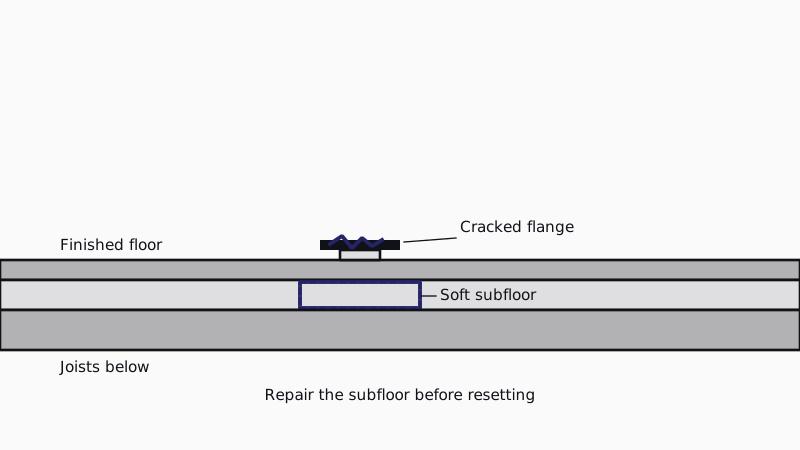
Press on the floor around the toilet. Spongy wood, a black stain or a musty smell is a sign of water getting in. The flange fix then becomes a carpentry job, and a plumber should assess it before the toilet goes back. Slab-on-grade homes, common in Temecula's tracts, may have no wood floor under a first-floor toilet, but the flange can still be cracked or set low after a floor was added.
Upstairs bathrooms in two-story homes, such as many local tract homes, add a second risk. A leak at a second-floor toilet can show up as a ceiling stain or a drip in a light fixture below, so a stain downstairs is a cue to inspect the bathroom above. Once it has gone that far, the guide on water leaking from a ceiling light lays out the next steps.
Is the leak coming from the tank rather than the bowl?
Water on the outside of the tank, or drips from the bolts or the base of the fill valve, put the fix inside the tank. A cracked tank has to be replaced, while bolts, washers and the fill-valve gasket cost little. To test, slip a dry towel under the tank and inspect the bolts after a flush.
The leaky toilet tank repair page is a guide of its own for tank problems. Water that keeps moving inside the bowl points to a running toilet instead, covered on the page about a toilet that keeps running.
In this area hard water makes matters worse. Rancho California Water District's 2020 to 2023 reports put average hardness around 230 to 240 mg/L, so mineral crust forms on tank bolts, the seat and the fill valve and can make old gaskets leak sooner. Cleaning before you reassemble helps new seals bed properly.
When does a new toilet beat a repair?
Buy a new one when the bowl or tank is cracked, when an aging toilet is failing in several places, or when parts no longer fit. Repair is cheaper if the fault is just a wax ring or a washer, but damaged porcelain tips the balance to replacement. The EPA puts household leakage at more than 9,300 gallons a year on average, so a persistent one is worth stopping.
Installing a new toilet resembles resetting the old one, with the extra step of matching the rough-in distance from the wall. Pricing and scope are on the toilet replacement cost page, and the plumber for toilet leaks page says when to call. For a quote, go to the quote page.
Common questions
What if the toilet leaks just after flushing?
A leak that shows up only after a flush is nearly always at the base. Flushing sends water through the waste joint, and a failed wax ring or a loose closet bolt lets it escape. A leak from the tank bolts also appears after a flush, as the tank empties and refills.
Can I use caulk or sealant to fix a leaking toilet base?
No. A ring of caulk conceals a leak and may hold water under the toilet. The seal is the wax ring or waxless gasket, not caulk. A bead of caulk after the repair is cosmetic and some plumbers leave a gap at the back so a leak can show.
What shows that a wax ring has failed?
Look for water at the base, a sewer smell, a rocking toilet, a stained floor, or a toilet that was recently moved or reset. When water shows up after flushing while the supply line and bolts stay dry, suspect the wax ring.
Is a leaking toilet an emergency?
Count it as urgent but not always an emergency. Close the valve behind the toilet if water keeps coming. Clean water from a supply line can damage floors fast. Water at the base after a flush can carry waste water, so keep people away and dry it.
Will a leaking toilet harm the ceiling underneath?
Yes. When a second-floor toilet leaks at the base, the subfloor can soak through and appear as a ceiling stain on the level below. If you see a stain, check the toilet above and stop the leak before repairing the ceiling, or the stain will return.
This guide is one of many on Temecula Pipe and Repair.
Updated