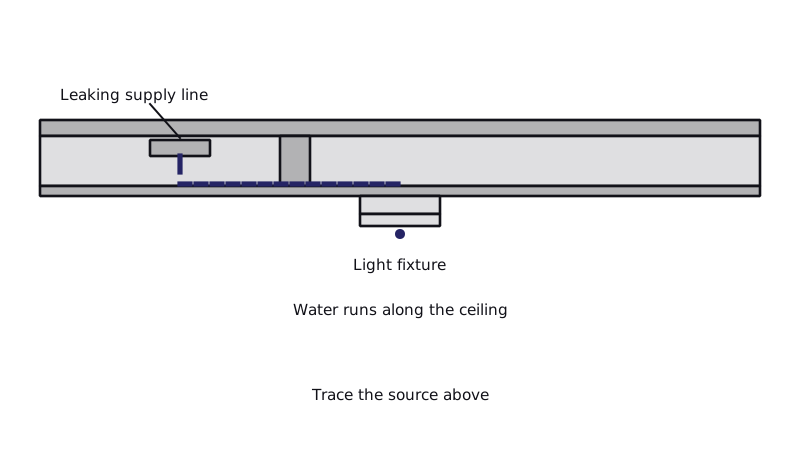
When a ceiling light is dripping, keep people clear of it, turn the circuit off at the breaker panel without standing in water, and leave the switch alone. After that, catch the water and trace where it begins. This kind of leak falls under leak repair help, and it usually needs both a plumber and an electrician.
Which steps come first if a light fixture starts to drip?
Stay out from under it, switch off that circuit at the panel if you can get to the panel with dry footing, and keep away from the fixture and any damp switch. If the panel is in a wet area, or you see sparks, smoke or smell burning, get out and call 911. Never touch the fixture or run the light.
Then contain the water:
- Set a bucket or tub beneath the fixture and lay towels around it. Move furniture and rugs aside.
- When the flow is heavy and the main shut-off is known to you, close it so the water slows while you search for the source.
- Photograph the ceiling, fixture and damage before cleaning up, since your insurer could request them.
- Do not poke at the ceiling near the fixture. A bulging drywall ceiling holds a lot of water, and the wiring is in there. Leave relief holes to a professional, or make one only well away from the fixture and wiring and with the power off.
Never mix electricity and water. Even after it dries, a fixture that has been wet should be inspected by an electrician before you switch it on again.
What is the source of the water?
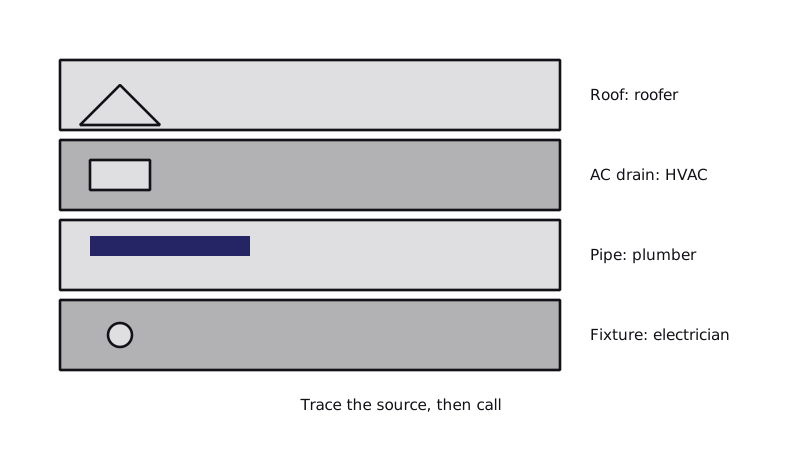
Look above the light first, though water runs along joists and wires, so where it drips may sit a few feet from the true leak. Typical sources are an upstairs bathroom, a supply or drain line, the air conditioner condensate line, an attic water heater, or the roof in the rain.
Consider what lies right over that room:
- Upstairs bathroom or laundry. Possibilities are a leaking shower pan, toilet seal, supply line or drain. Two-story homes in Redhawk, Harveston and Rancho California are typical places for this, and the page on a leaking toilet at the base and the shower leak page cover the usual culprits.
- Air conditioner. Cooling runs hard through Temecula summers, and a blocked condensate drain, or an overflow pan that has filled in an attic unit, can drip through a ceiling. Check whether the drip follows the AC cycling.
- Water heater or plumbing in the attic. Some homes of the 1990s and 2000s put the heater or lines in the attic. A leak there can run for days before it shows.
- Roof. If the leak shows up only in rain, the roof or a flashing is the likely cause. That is a roofer's call, not a plumber's.
- Supply line or drain in the wall. Pinhole leaks in older copper are a known cause, and hard water makes them more likely. Rancho California Water District's reports put average hardness around 230 to 240 mg/L, which is very hard.
How can I tell whether plumbing is to blame?
Start with the timing. A leak that runs only when someone uses the upstairs shower, toilet or washer is a drain or fixture leak. One that runs all the time, day and night, is a pressurized supply line. A leak only in rain is the roof. If it follows the air conditioner, the condensate line is at fault.
Two tests help:
- The meter test. Shut every tap and appliance off and observe the water meter. If the dial turns, a pressurized line inside the house is leaking, and closing the main would stop it.
- The usage test. Ask someone to run one fixture upstairs while you watch the ceiling. A drip within a minute or two identifies that fixture.
Closing the main and seeing the ceiling stop dripping fairly soon means a supply line was responsible. Dripping that carries on after the main is off suggests water already trapped above, or a roof or AC source. More signs are listed in recognizing a burst pipe, and a leak that runs steadily is covered in urgent help with a burst pipe.
How much damage can a wet ceiling do, and how quickly should I act?
Saturated drywall can sag and drop, insulation keeps water pressed against wood, and mold may start within one to two days. To limit mold, the EPA recommends drying wet materials in 24 to 48 hours. Wiring in the wet ceiling is the biggest safety concern, followed by weight on the drywall.
Act the same day. Turn off the water and the circuit, open windows or run fans where safe, and carry out wet belongings. Wet insulation and drywall frequently have to be removed, because leaving them damp invites mold. A small area is something a homeowner can handle with protective gear. Extensive or long-running water damage, or mold across a large area, belongs to professionals. Read your insurance policy and tell the insurer quickly, since late reporting can matter.
Should I phone a plumber or an electrician?
Frequently both. The plumber locates and repairs the leak, while an electrician tests the circuit and fixture before they go back into use. With an unknown source, ring the plumber first, since halting the water precedes drying out and rewiring.
In California, any job needing a permit calls for a contractor license, and repairs to a wet electrical circuit sit on the electrician's side. Plumbing work that opens walls, replaces lines or changes a water heater may also need a permit. Within Temecula the office is Building and Safety, while parcels outside the city go through the county. Do not repair wiring yourself.
If the leak is active and you cannot stop it, use the emergency plumber page. To get a plumber to trace and fix it, go to the quote page and say where the light is, what sits above it and how frequently it drips.
Common questions
Can I simply leave the switch off and wait?
Turn the circuit off at the breaker, not only the wall switch, and stay clear of the fixture. A switched-off fixture can still be live if the breaker is on. It is safer to wait for an electrician than to flip the breaker back on to see whether the light still works.
Should I make a hole in the ceiling to let the water out?
Only if a bulge is holding a large amount of water and you can safely do it away from the fixture, with the power off. A small opening lets the water run into a bucket and can keep the ceiling from collapsing. If unsure, leave it for a professional.
Will the ceiling light work again after drying?
Possibly, but have an electrician check it first. Water can corrode the contacts and damage the wire insulation inside the box, which causes shorts or fires later. Replacing the fixture and checking the cable is often cheaper than the risk, and it gives you a documented, safe circuit again.
Does home insurance cover a ceiling leak?
Often it does for sudden, accidental water damage, but the policy and the cause decide. Some policies leave out long-term seepage or failures of upkeep. Take photos, keep receipts and call your insurer early. Ask what must be done before repairs, so that nothing you do voids the claim.
Can an air conditioner leak through a ceiling light?
Yes. A blocked condensate line or a cracked drain pan may spill over into the ceiling beneath it. If the drip starts when the AC runs and stops when it is off, switch the system off and call an HVAC contractor, then deal with the ceiling.
This guide is one of many on Temecula Pipe and Repair.
Updated