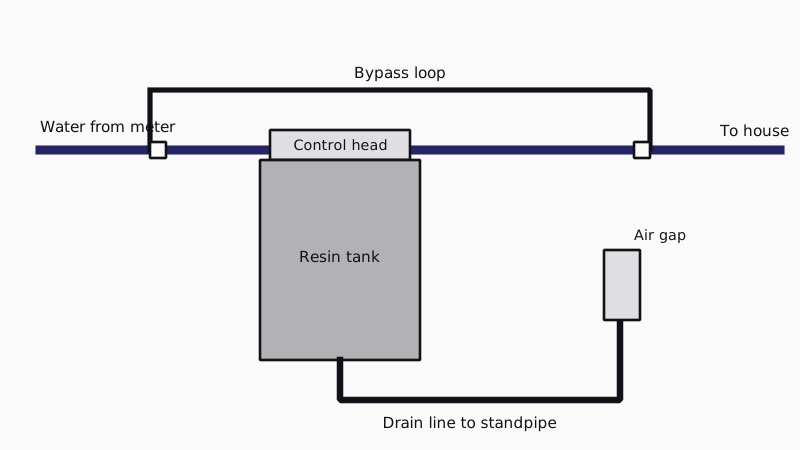
On a schedule, a healthy softener pushes brine through its resin tank, and that adds a small, predictable amount to your water use. A broken one can add far more, when its valve sticks mid-cycle and lets water run to the drain for hours or days. If your bill jumped soon after a softener went in, or out of nowhere with an old one, check the meter before you blame the machine. The water softener page covers choosing and installing one; this page is about the bill.
Does a softener consume extra water?
Yes, but only a modest amount. In each regeneration the unit backwashes the resin bed, draws in brine and rinses it out, and all that water goes to the drain. The quantity depends on the model, the hardness of the supply and the size of the household, so the manual for your unit is the best source. A typical home sees a small bump, not a doubling.
A metered unit regenerates only when its capacity is used up and so wastes less than a timer that cycles on a fixed schedule. Old timer units set to run every night can waste water if nobody has adjusted them.
Hard water is why softeners exist here. Rancho Water's own reports put average hardness around 230 to 240 mg/L, roughly 13 to 14 grains per gallon, in the 2020 to 2023 reports. Harder water makes the softener regenerate more often. Your supplier's current Consumer Confidence Report gives the latest number, on ranchowater.com for that district's customers, and an address served by a different district has its own.
Do the salt or the settings change how much water I use?
Salt does not alter your water use, but settings do. A resin tank set more sensitive than the real hardness requires will regenerate more than needed, and a unit too small for the household will regenerate often. The simplest way to stop waste is to set hardness from a test at your own tap instead of a guess.
Have the installer set the hardness number from a test kit reading at your tap and show you how regeneration timing works on your model. Many people also overlook another habit: softened water feels slick, so showers can run longer without anyone noticing, and the extra use appears on the bill.
Softening does not cut what the district meters. It can, however, cut scale on heaters, fixtures and appliances, which matters in a valley with water this hard. See hard-water scale prevention. A properly sized unit leaves water pressure alone, but a clogged resin screen or an undersized bypass can reduce flow, and that feels like a separate fault.
If you share a house and the bill climbs in a pattern that fits only one season, irrigation is a likelier cause than the softener. What a visit includes is explained on the installation service page.
At what point should I ring a plumber about my softener?
Call when the meter moves with the softener isolated and you cannot say why, when you find water at the unit, when the valve will not advance, or when you want another regeneration setting after the household changes. Resetting a timer after a power cut is a fair do-it-yourself job; opening the control valve or altering plumbing is not.
If you are considering replacing the unit, ask for a metered model and a clean drain connection with an air gap. The softener installation cost page breaks down the elements of a quote, and the installation steps show how a unit is plumbed in.
To get a visit through Temecula Pipe and Repair, send your details through the quote page. We forward the request to a local plumbing business, and businesses accepting such requests pay us a fee.
Which softener faults can push the bill up?
Common faults include a control valve stuck in backwash or rinse, a timer or circuit board that failed after a power cut, a leaking brine line or tank fitting, a bypass valve left half open, and a drain line connection that has come loose. Each of these can let water escape down the drain or onto the floor near the unit.
Check for a wet floor under the tank, salt crust on fittings, or a drain hose still running when the cycle should be done. Many units show the cycle position on a display or dial; if it never advances, the valve is stuck.
A softener fault does not rule out trouble elsewhere, so check the rest of the house too. The no visible leak guide goes through irrigation, toilets and hidden lines.
Is the softener really the reason my bill rose?
Let the meter decide. Switch off all taps and appliances, write down the reading and the leak indicator's position, and watch it for several minutes. Next close the softener's bypass or its inlet valve and look again. Flow that stops once the softener is isolated means the softener or its drain line is the source.
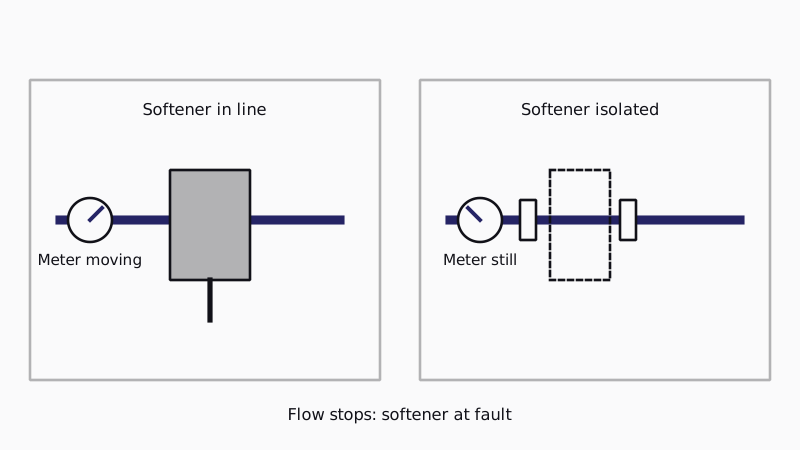
Sound is a second clue. Hold your ear near the softener while nobody uses water. A steady trickle or rushing sound, plus water moving through the drain hose toward the floor drain or standpipe, shows that it is stuck in a cycle. Compare against your bill dates: a jump starting the month after an install or a power outage is suspicious.
The EPA suggests this test for any suspected leak: note the meter reading, keep the water unused for two hours, then check once more, since any change shows water is flowing somewhere. See the longer high water bill guide for other causes.
Common questions
How much time does a softener inspection take?
A basic inspection of the control valve, drain line, bypass and settings often fits inside an hour, though diagnosing a stuck valve or ordering parts takes more. The plumber can give a firmer estimate after viewing the unit and learning its age.
What should a plumber be asked about a softener?
Learn what is included in the visit fee, whether the unit is metered or timed, the cost of the brand's service parts, the water used per regeneration on that model, and whether the drain has an air gap. Ask for the contractor license number as well, and verify it with the state.
Should I be home for a softener visit?
Typically an adult is needed to unlock the garage or utility area, show the unit and agree the price. If the softener is in a locked or shared space, organize access in advance and mention it in the request, so the plumber is not stuck outside.
Can a softener push up a bill with no water in sight?
Yes. If the drain hose empties into a floor drain or standpipe, the water disappears out of sight. The only sign may be a moving meter or a faint rushing sound near the unit. That is why testing with the meter and the bypass closed is more reliable than hunting for puddles.
Updated