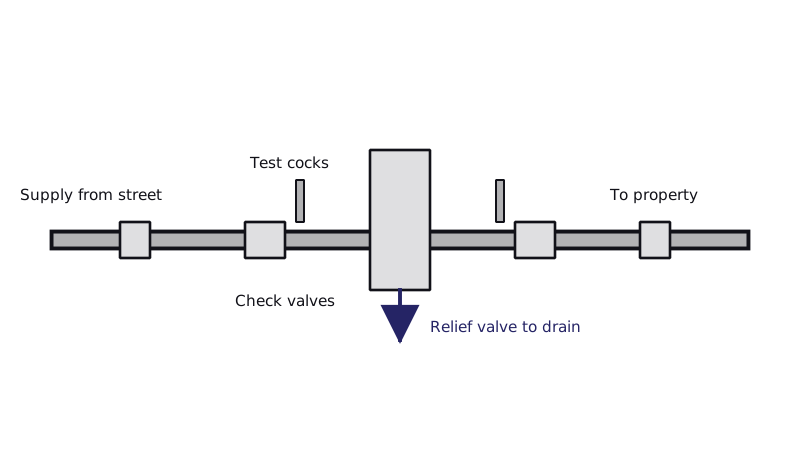
Testing a backflow device is not something you do yourself. Someone trained hooks a gauge kit up to the assembly, closes its valves in a set order, reads the pressures and writes a report for the water supplier. Your part is knowing which devices you have, keeping the test current and fixing what fails. The same rule-following mindset covers permits. This page sits under permits, codes and gas work and covers both the test and the paperwork.
What does a backflow test actually involve?
The tester fits a calibrated gauge to the test cocks on the device, closes the valves one after another and reads whether the check valves hold and the relief valve opens at the right pressure. A short visit is all it takes, and the result goes on a form for your water supplier. A failed device is repaired or replaced, then tested again.
Backflow means water moving the wrong way, drawing pollutants from a sprinkler line, a boiler, a pool fill or a commercial process back into the public pipe. Devices installed to stop it include:
- Reduced pressure assemblies, used where the hazard is serious.
- Double check assemblies, for lower hazards.
- Pressure vacuum breakers and atmospheric breakers on irrigation lines.
Most single-family houses have a simple hose-bib vacuum breaker and nothing to test. Properties with irrigation, fire lines, pools with an autofill, or commercial use are more likely to have a device the supplier wants tested on a schedule, often once a year. Check yours with the supplier. See the homeowner backflow page and, for businesses, commercial backflow testing.
Who is allowed to test, and who tells me when?
Your water supplier sets the rules and generally keeps a list of testers it accepts, so ask it first. In the Temecula area that is usually Rancho California Water District, which you can reach on 951-296-6900, or Eastern Municipal Water District for some addresses. The water bill shows which district serves you.
A supplier typically sends a notice when a test is due. Ask three questions: which testers are accepted, where the result is filed, and what the deadline is. Do not hire a tester who can't show current qualifications for the district you are in.
Zip codes alone don't settle it. Temecula addresses sit in zip codes such as 92590, 92591 and 92592, but district boundaries run along streets, not zip lines, and some French Valley and Winchester addresses sit in a different district again. Use the bill, not the zip code.
To get a plumber to book the test or swap out a failed assembly, go through the quote page. The backflow testing services guide lists what to expect on the day.
What is the process for a plumbing permit in Temecula?
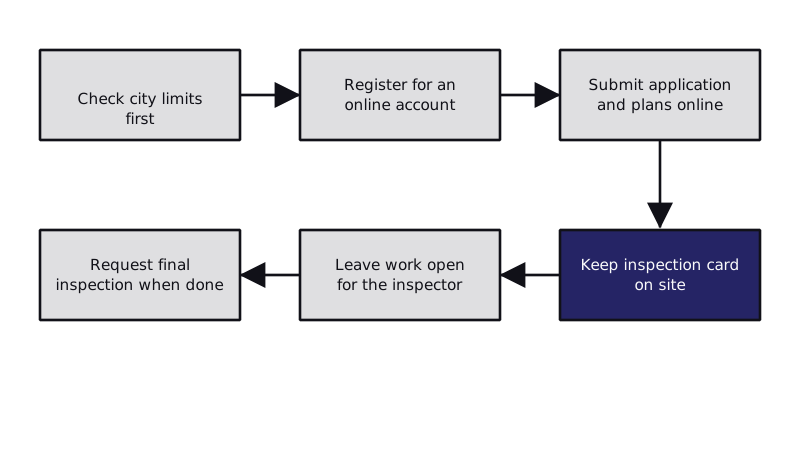
The City of Temecula Permit Center at 41000 Main Street (first floor) issues permits for addresses inside city limits. The city says to check that the property is in city limits, register for a Citizen Self Service account about a week before you submit, fill in the building permit application and send it with plans online. Permits phone: 951-694-6476.
A few practical points from the city's page:
- The office is open Monday to Friday from 8 a.m. to 5 p.m., closed on holidays.
- Questions about general help or online submittals go to [email protected].
- Riverside County Building and Safety, not the city, serves unincorporated parts of the valley like Wine Country east of the city and French Valley.
- For Fallbrook, Rainbow and the part of De Luz in San Diego County, the permit office is San Diego County's.
In California, a contractor license is generally needed for any job requiring a permit and for work of $1,000 or more in labor and materials. The plumber you hire usually files for the permit and schedules the inspections as part of the quote. Have that in writing.
How do I complete a plumbing permit form and prepare the plans?
Write in the address, owner, contractor and scope in plain words (for example "replace 40-gallon gas water heater, same location"), and add a simple drawing if the office requests one. On small jobs, a tidy sketch showing the room, fixture, pipe sizes and shutoff is often enough. Ask the Permit Center what it expects.
For bigger work, a sketch becomes a plan: a floor plan with each fixture, the pipe routes, pipe material and size, and the water heater, drawn to rough scale. Plumbers who do this daily can draw it faster than you can. The city's page lists minimum submittal requirements, so read those before you start, since the checklist differs from job to job.
When the permit is issued you get an inspection card. Keep it on site. The work must stay open for the inspector, then you request a final inspection when the job is done.
At what point does a plumber take over?
Backflow testing, anything involving gas lines, and any job that calls for both a permit and an inspection belong with a contractor. You can tidy up around a device and watch it for leaks, but opening a pressurized assembly or changing it without a test is where trouble starts.
Signs that a backflow device needs attention are water spitting from the relief valve, a leaking or cracked body, a missing test tag and a past-due notice from the supplier. On a first visit, a plumber may also run a camera inspection of the line to see whether the problem is in the device or downstream. For what that adds, see the inspection cost guide.
Start by sending Temecula Pipe and Repair the address and the device type; the request is forwarded to a local plumbing business, which then arranges the visit.
Common questions
How much time does a backflow test take?
One assembly normally needs under an hour on site, and the tester files the report afterwards. A failed device adds time for repair parts and a retest. The district sets the paperwork deadline, so ask when the test is due and plan the visit before it, not the week it lapses.
What should I ask first when picking a backflow tester?
Confirm that the tester appears on your water district's approved list, what the visit costs, whether report filing is included, what happens when the device fails, and whether repairs are offered too. Where repairs are part of the job, obtain the contractor license number and verify it online with the state.
Is a plumbing permit needed to swap a water heater?
California generally requires a permit for replacing a water heater, and the inspection covers gas connections, venting, relief valve piping and earthquake strapping. For the rules that apply at your address, call the City of Temecula Permit Center on 951-694-6476, or the county office for addresses outside city limits.
Can I get a permit for my own house without a plumber?
An owner can often apply for a permit covering their own home, under certain conditions, but the permit office decides what it will accept and the work must meet code and pass inspection. Ask the Permit Center before you buy materials. For gas lines, backflow assemblies and main lines, hiring a contractor is the safer route.
Updated