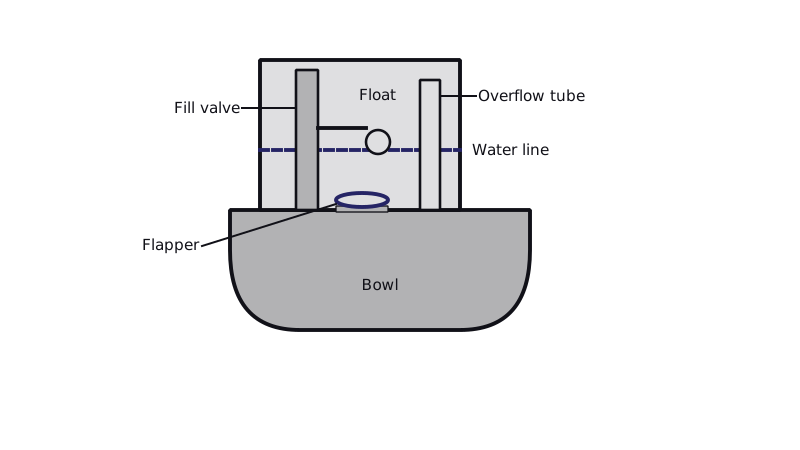
Take the lid off the tank and look inside. When water keeps trickling down the tall overflow tube, the fill valve or the float is the likely culprit. If the tank drains slowly and refills every few minutes, the flapper is leaking. A running toilet in most Temecula homes ends with a part that costs less than a lunch. Larger toilet jobs have their own toilet repair page.
What causes a toilet to run continuously?
The tank never gets to a settled full level. Either water leaks past the rubber flapper into the bowl, so the fill valve keeps replenishing it, or the level climbs high enough to pour into the overflow tube. Both come down to cheap wear parts, and hard water makes both worse.
Rancho Water's reports put average hardness around 230 to 240 mg/L, roughly 13 to 14 grains per gallon, in the 2020 to 2023 reports. Mineral crust on a flapper seat keeps the rubber from sealing, and rubber left for years in chlorinated water softens or warps. Older houses in the valley often still have the original flapper.
By EPA estimates, a typical home leaks more than 9,300 gallons in a year, and a running toilet ranks among the usual causes. Silent seepage into the bowl can lose far more than a dripping faucet, with no noise to give it away.
How do I work out which part has failed?
Drop some food coloring into the tank, then leave it fifteen minutes with no flushing. Color in the bowl means the flapper or its seat is leaking. A clear bowl with a tank that still refills points to a water level set too high, or to a fill valve that cannot shut off.
Run this test before you buy anything, since it spares you a pointless trip to the hardware store. One more check is free: compare the water line to the mark on the tank wall or fill valve body. A correct level is roughly one inch under the top edge of the overflow tube. Anything above that is draining away, and a faint hiss or trickle in the tube often gives it away.
Three signs point at the fill valve. It hisses as it refills and never goes quiet, the water keeps climbing after you push the float down by hand, or the refill finishes with a long whine. Swap the valve; kits suit most standard tanks and install using a wrench plus a bucket.
How do I fix a running toilet step by step?
Close the small supply valve on the wall below the tank, flush to empty the tank, then replace whichever part failed. A new flapper snaps onto the overflow tube pegs and hooks to the handle chain. A new fill valve screws through the tank floor. Open the supply again slowly and watch each connection for drips.
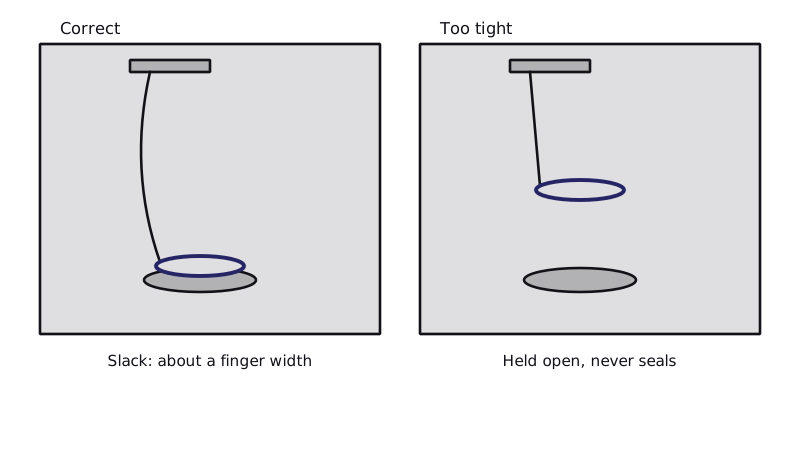
For a flapper: unhook the chain, lift the worn flapper from its pegs, rub the seat smooth with a cloth, fit a flapper of the same type, and give the chain a touch of play, about a finger's width, so the flapper can fall completely shut. Too tight a chain holds the flapper open; too long a chain can snag underneath.
When the level is too high on a float-cup valve, pinch the spring clip and move the cup lower on the rod, or use the small adjusting screw instead. With an older ball-and-arm valve, you can bend the arm gently down or turn the screw on top.
Do not use abrasive pads on the seat, and keep any bleach tablets out of the tank. Chlorine tablets are a well-known reason flappers fail early, so skip them if you have one in there already.
Why does my toilet run on and off by itself?
When a toilet refills with nobody flushing, a so-called phantom flush, the cause is a slow flapper leak. As the tank level sinks slightly, the fill valve tops it up, and this repeats every few minutes or every few hours. That is also why it can seem to run randomly or at night.
The intervals tell you something. A refill every few minutes means a larger leak, usually a warped flapper or a chain stuck under it. A refill every hour or two means a tiny seep, often only mineral crust on the seat. Either way the dye test and a new flapper handle it.
If the toilet runs continuously rather than in bursts, the flapper may not be closing at all, or the fill valve is stuck open. Check the chain first: a chain tangled around the handle arm is a common cause. After that, look at the fill valve cartridge for grit. Some valves have a removable cap that lets you flush the cartridge clear.
What about a Kohler or other branded toilet that keeps running?
A branded toilet fixes the same way, but it often needs a specific part. Kohler and similar makers sell flappers and fill valves that match the model, so read the model number inside the tank or under the lid and buy the matching kit instead of a universal part.
Two-piece and one-piece toilets differ mostly in how the tank bolts down, not in how the inside works. Modern designs with a canister-style flush valve use a cup-shaped seal rather than a flapper. If yours has one, the seal, not a flapper, is the part that wears. Replacement guides from the manufacturer match model numbers to parts, and a plumber will carry spares of the common types.
When the porcelain has cracked, or water seeps out at the tank base or the floor, stop repairing and read the next section. A part swap will not cure those.
What if the toilet moves at the floor or the repair does not hold?
A toilet that rocks on the floor has a loose or failed base seal, a different problem from a running tank. Snugging the closet bolts might do it, yet a cracked flange or a leaking wax ring requires lifting the toilet. Leave that to a plumber unless you are comfortable pulling a toilet yourself.
Never over-tighten the nuts, because porcelain cracks. Flooring around the base that feels soft, looks stained or smells off hints at long-term seepage, so the subfloor may need inspection. Older homes with wooden subfloors can suffer from slow leaks in a way slab homes do not.
Call a plumber if it keeps running with new parts, if water shows up around the base or on the ceiling beneath, or if the supply valve refuses to close. The plumber we pass your request to comes to your home, and a quote request gets you a price before you agree to anything.
Common questions
How many gallons does a running toilet lose?
It hinges on how big the leak is. A faint flapper seep may lose little, but a toilet that runs constantly can waste hundreds of gallons a day. For comparison, the EPA says the typical home leaks above 9,300 gallons per year, so a fast repair soon repays its cost.
Can I repair a running toilet without hiring a plumber?
Often, yes. Fitting a new flapper or fill valve is an easy job needing just a wrench and a bucket, and swapping tank parts rarely calls for a permit. Ring a plumber when the shut-off valve will not close, the base leaks, or the toilet still runs after both parts are new.
Does a running toilet raise my water bill?
It does, since the water meter tallies each gallon that escapes down the drain. You pay a second time if sewer charges are based on that same water. Check your meter by turning off every tap, then watching the leak indicator for movement. If it spins with nothing running, look at the toilets first.
How long does a flapper last?
There is no set life. Flappers commonly last several years and fail sooner in hard water or with bleach tablets in the tank. If a toilet is running and the flapper is old, stiff or covered in crust, replace it as a first step because it costs little and takes minutes.
Should I replace the whole toilet instead?
Not just for a running tank; repair the part first. Buying a new toilet makes sense when the porcelain has cracked, the old unit wastes a lot of water, or repairs keep failing. Which case applies to you is something the plumber can tell you, and a written quote shows the price before you decide. The home page lists every kind of job we handle.
Updated