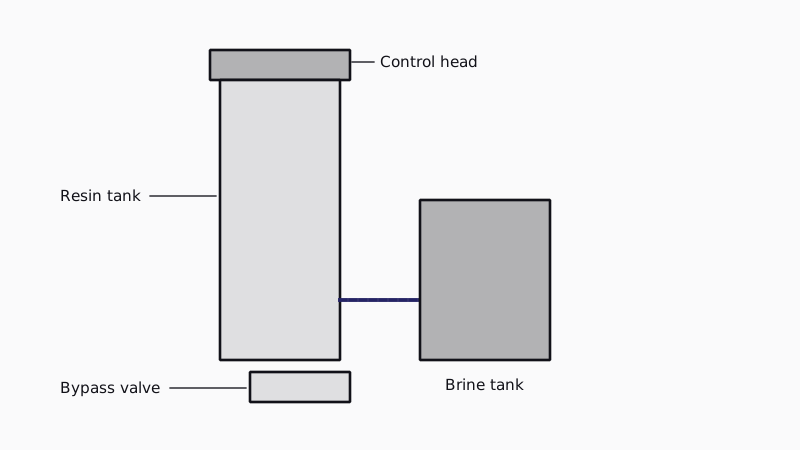
A proper installation service tests your water first, chooses a softener sized to the household and its hardness, fits it on the main line with a bypass, leads the drain line to an air gap, programs the control and shows you how to refill salt. We arrange local plumbing businesses for that on the water softeners page, and this guide explains what a good visit looks like.
What should a softener installation service cover?
A full service covers a site check, a hardness test, delivery or fitting of the unit, cutting into the main line with a bypass valve, a drain line ending in an air gap, power hookup, setting the hardness and regeneration, a leak test, and a walk-through of salt, controls and servicing. Each item should be named in the quote.
Ask exactly what the price covers and omits: the softener, fresh shutoff valves, copper or PEX fittings, a drain tie-in, an electrician-installed outlet where none exists, hauling away an old unit, and any permit. One lump sum without itemization is hard to compare. The softener installation cost page lists the factors that move the figure.
Which facts about my water matter before installing?
Know your hardness, whether you are on a utility supply or a private well, and any iron, manganese or other problems. Hardness above 180 mg/L is classed as very hard by the US Geological Survey, and Rancho California Water District's reports have put its average around 230 to 240 mg/L. Parts of the area are served by Eastern Municipal Water District, so look at your bill.
A test strip or lab test reports hardness either as mg/L or as grains per gallon, and softener settings use grains. Divide mg/L by 17.1 to convert. For more on the numbers, read preventing hard water scale. Correct sizing rests on household headcount plus water hardness, which is why a plumber asks about both.
What about manuals and do-it-yourself installs?
Every brand publishes an installation manual for each model, and the plumber works from it, be the make Whirlpool, Rheem, AquaSure or something else. Manuals are normally on the maker's site or inside the box. A competent homeowner can install some units, but permits, backflow rules and a leak-free connection to the main are why many choose a plumber.
If you do read a manual, check the sections on the bypass, drain, air gap, pressure limits and winter protection. Under California rules, plumbing work totaling $1,000 in labor and materials, or any job that needs a permit, generally requires a contractor license. A permit for main line work may be needed from City of Temecula Building and Safety on 951-694-6439, or the county for properties outside the city.
How do I request an installation?
On the quote page, enter your address, say whether the supply is city water or a well, and add the household size and your goal. We pass the request to local plumbing businesses that pay us a fee, and one of them will contact you. Phones are answered on weekdays, 9am to 5pm. Every job we handle is listed on the Temecula Pipe and Repair home page.
Can you soften well water?
Often, but test first. Wells in Wine Country, Aguanga and De Luz vary in hardness and may carry iron, manganese or sulfur, which a standard softener handles only in small amounts. A water test tells the plumber whether a filter, an iron-removal stage or a different system is needed alongside the softener.
With a septic system, ask how softener brine affects it, since opinions vary and the answer depends on the system. Wells need pressure tank and pump checks too, because a softener adds a small pressure drop. Treating well water properly can call for a sediment filter before the unit, and the plumber ought to explain why.
Why does a softener need an air gap and a drain?
A softener regenerates by flushing brine to a drain. The air gap is a purposeful space between the drain line and the drain or standpipe, so wastewater can never siphon back into the unit and the supply. The plumbing code requires protection against backflow, and the plumber sets the drain line to suit.
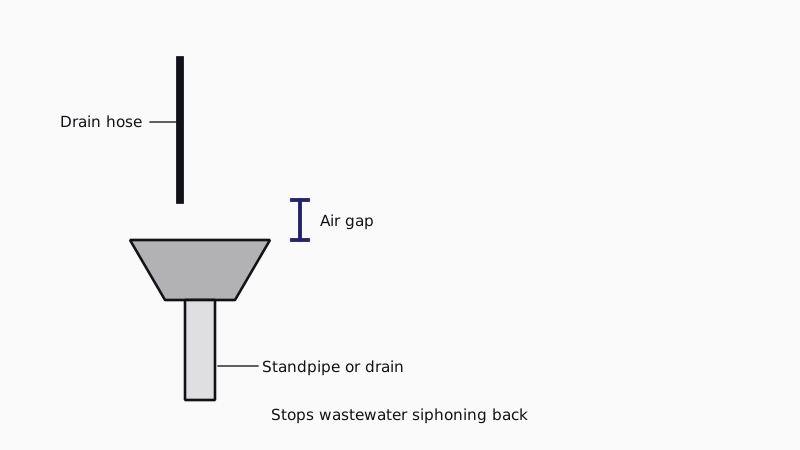
The drain can be a standpipe, a laundry tub or a floor drain, and a line run too far or too high can cause trouble. Salt-based softeners discharge brine, and some California communities restrict or ban it because of salt in wastewater. We have not checked the rule for every part of the valley, so put the question to your water or sewer provider, which is Rancho California Water District or Eastern Municipal Water District, before you buy.
How do I compare installation companies?
Request a written quote from each company that names the model, size, inclusions and exclusions, hardness setting, drain and air gap details, permit handling, and service terms. Ask how long the install takes and what happens if a leak appears afterward. Compare what is covered, not only the bottom line.
Beware pressure sales and unsupported claims about health benefits or "no maintenance" systems. Salt-free conditioners are a different product from a softener, since they do not remove hardness. A reasonable company will explain this plainly. California requires a written contract for work over $500, and caps a deposit at 10 percent of the price or $1,000, whichever is lower.
Where does a whole-home softener go?
Typically on the main line near where it enters the property, be that a garage, utility closet or side yard, with a drain and an outlet within reach. The unit goes downstream of the main shutoff and the pressure regulator but ahead of the water heater and the branch lines. Outdoor hose bibs are often left on hard water so irrigation does not waste softened water.
A bypass valve allows the unit to be isolated for service. A plumber also checks that your home has room, a level floor and access for salt bags. If the main line is in a hard-to-reach spot, such as behind a finished wall, the install costs more. Test pressure beforehand, because a house with high pressure needs a regulator; the guide on adjusting a water pressure regulator valve explains.
Common questions
How long is a softener installation visit?
In an ordinary single-family home with a clear spot, a drain and an outlet, expect a few hours. Allow extra if the job needs new pipe, an electrical outlet or a drain tie-in, or when the main line is awkward to reach.
Can a water softener be installed outside?
Sometimes, in a sheltered, shaded spot, protected from sun, rain and freezing. Many models are meant for indoor or garage use. Check the manual for ratings. Colder areas such as Aguanga need freeze protection, and a plumber can advise where the unit will survive.
Will a softener affect my water pressure?
A small drop is normal, because water passes through the resin tank and valve. A big drop points to a clogged filter, a wrongly sized unit or an old pipe. A plumber can measure pressure before and after to confirm that the unit is not the cause.
Is a permit required to install a softener?
It depends on the work. If the plumber alters the main line or drain, a permit may apply. Check with City of Temecula Building and Safety, or the county where the address is unincorporated, and have the plumber state in the quote who handles it.
Is salt-free the same as a softener?
No. A salt-free conditioner changes how minerals behave but does not remove them, so hardness numbers stay the same. A softener removes calcium and magnesium with salt-based ion exchange. Choose by what you need: scale control, softer feel or both, and check independent test data.
Updated