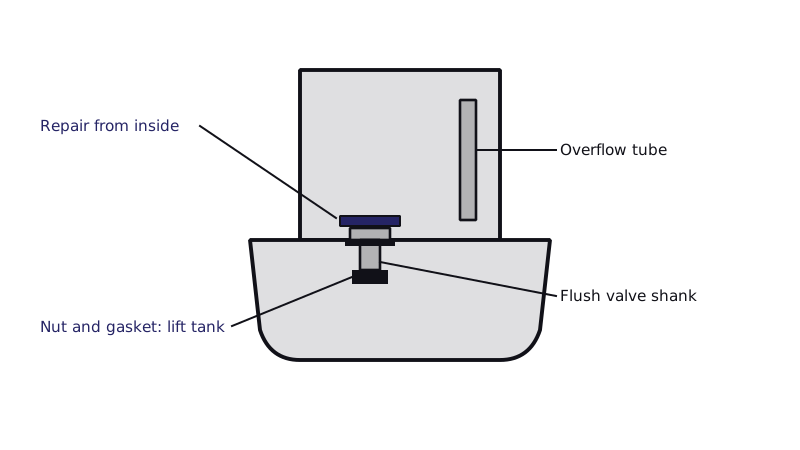
A leaking flush valve can sometimes be fixed with the tank left in place, and sometimes not. When the leak comes from the rubber flapper or the worn seat beneath it, you can often repair it from inside the tank. Should the valve body be cracked, or its nut and gasket below the tank be leaking, the tank must come off. Use this guide to place your own case; the toilet repair section gives the bigger picture.
What does a flush valve do, and how does it fail?
The flush valve is a big drain fitting sitting on the tank floor. It has a seat that the flapper seals against, an overflow tube, and a threaded shank that passes through the tank into the bowl, sealed by a rubber gasket and held by a big nut underneath. It can leak at the seat, the gasket, or the overflow tube.
Faults that show up:
- Seat worn or pitted. The flapper can't seal, so the tank refills by itself.
- Gasket leak under the tank. Water drips onto the floor from the joint between tank and bowl.
- Cracked overflow tube. Water drains continuously down the tube.
- Corroded valve body. Common on older brass or aged plastic parts.
To see whether water slips past the seat, run a dye test: wait after putting food coloring in the tank. According to the EPA, dye that reaches the bowl within 10 minutes means a leak. Then try the cheapest fix, a new flapper, before anything else.
Which flush valve repairs can be done without removing the tank?
Replacing the flapper, cleaning the seat, fitting a seat-repair kit, using a kit made to go over the existing seat and overflow tube, and renewing the flapper chain can all be done with the tank in place. Fixes that touch the nut and gasket under the tank, or replace the whole valve, generally require lifting the tank off.
Details on the in-tank options:
- New flapper. Match the size and style to your valve; see the flapper valve types guide.
- Clean the seat. Scrub mineral crust with a nonmetal scouring pad.
- Seat repair kit. Some kits bond a new seat ring over a worn one with adhesive or a ring, so a pitted seat can seal again. Availability and fit vary by toilet, so check the instructions.
- Repair-style flush valve kits. Certain products are designed to be installed on the existing valve, and the box says whether the tank must come off.
Hard water roughens seats over time. Rancho Water's own reports put average hardness around 230 to 240 mg/L, roughly 13 to 14 grains per gallon, in the 2020 to 2023 reports, so a seat that has gone rough here is a regular culprit.
In which cases must the tank be lifted off?
The tank comes off when the flush valve's gasket or nut is leaking, when the shank or body is cracked, or when you want a full new valve and the kit says it replaces the original. With a two-piece toilet, the nut is under the tank, so the valve cannot be swapped without lifting it. A one-piece toilet is different; there the tank is not removable.
A bottom leak shows up as dampness at the tank and bowl seam, wet tank bolts, or a wet floor patch just after flushing. When the source is that seam, repair the gasket or the valve seal. Water seeping out under the bowl itself is the wax ring, a different job.
For one-piece toilets, a repair kit or replacing the toilet is often the realistic route. Replacing a toilet shows how the comparison looks.
How do I replace a flapper or seat from inside the tank?
Close the wall valve, flush the tank dry, and sponge out whatever remains. Detach the chain, take the old flapper off its pegs, clean the seat and put on the new flapper. Hook the chain back with roughly half an inch of play, restore the water and watch a few flushes. Run a dye test afterward.
If you are using a seat repair kit, follow the instructions closely, since the surface must be clean and dry and the adhesive needs cure time. Rushing the cure is the main cause of a repeat leak.
Take photos before you disassemble anything. Don't overtighten plastic parts, and don't force a corroded fitting, since a cracked tank is a replacement. Soak stubborn parts and be patient.
What if the tank must come off?
In that case, close the water, empty the tank and detach the supply line, then undo the nuts holding the tank to the bowl and lift it off with a helper. Set it down on a towel, fit the new valve and gaskets, then work backward through the steps, tightening evenly. The gasket between tank and bowl and the bolts are usually replaced along with the valve.
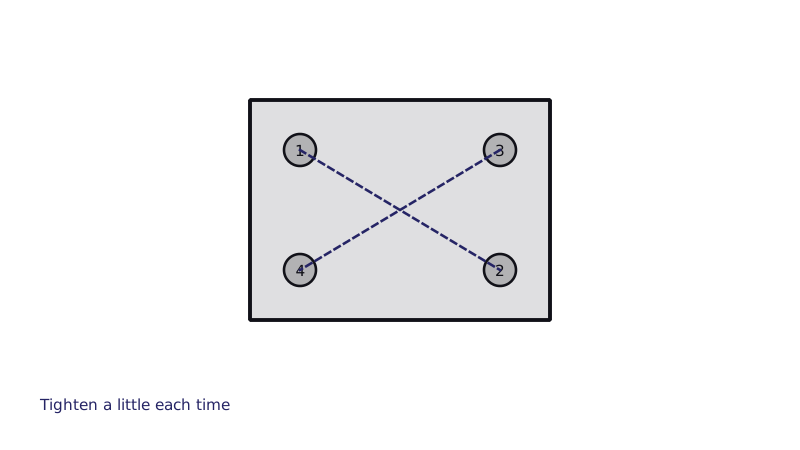
Tanks are heavy and porcelain is brittle, so many people hire out this job. Tighten the tank bolts alternately, a little each time, and stop when snug. Test with the water on and watch for drips at the bolts for several flushes, then again the next day.
If the repair turns out bigger than expected, use the quote page to have Temecula Pipe and Repair set up a visit, and tell us whether your toilet is one piece or two, its age and where the water shows.
Common questions
How long does replacing a flush valve take?
A flapper or seat repair takes under an hour. Lifting the tank, swapping the valve and gaskets and reseating everything typically needs one to two hours from a plumber, longer if bolts are seized. A firmer estimate is possible once the plumber has seen whether the toilet is one piece or two.
Which questions come first when hiring for a flush valve job?
Ask whether the price covers the valve, gaskets and tank bolts, and whether repairing the flush valve makes sense for a toilet this old. Find out what the visit fee includes. Request the contractor license number too, and look it up online through the state contractors board.
Must someone stay home during the job?
In most cases an adult ought to be there to admit the plumber to the bathroom, agree the price and test the flushes at the end. All the work is in one room. If nobody can be there, mention it in your request and we'll arrange access in advance.
Would replacing the entire toilet be wiser?
If the toilet is old, cracked, uses much more water than newer models or keeps failing, replacement may be the better value. For a newer toilet with one failing part, repair is usually cheaper. Ask the plumber to price each route next to the other; both figures come in a written quote.
Updated