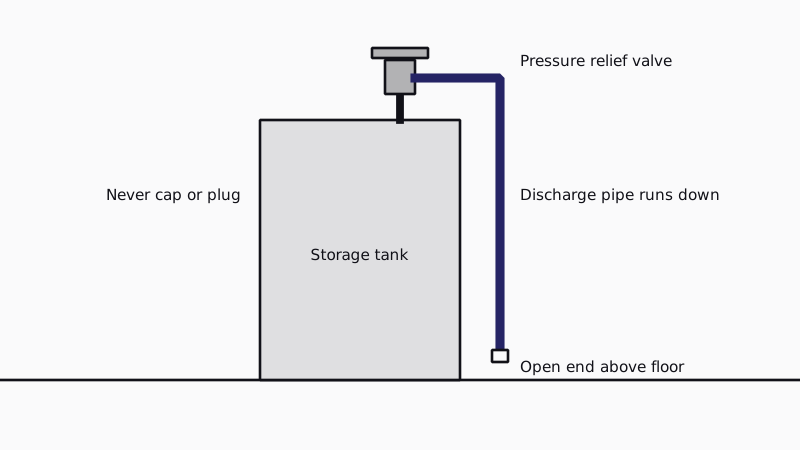
A relief valve is replaced rather than repaired. It is a sealed spring device that either works or fails, and one that leaks or has opened too many times costs little to swap. Working out why it opened is the harder job. Other tank problems are listed under water heater repair.
Why does a water heater have a pressure relief valve?
The valve protects the tank from overheating or from excess pressure. When pressure or temperature crosses a preset limit, it opens and sends the water down a pipe to a safe spot. Most storage tanks have a temperature and pressure valve, often called a T&P valve, on the side or top.
The set points are printed on the valve, commonly 150 psi and 210 degrees Fahrenheit, but read the label on yours. A healthy valve stays closed in normal conditions. As a safety part, it must never be plugged, capped or swapped for a plain fitting. The pipe that carries its discharge must stay clear as well. A shortcut here can cause serious injury, since a tank with no way to vent can fail violently.
How do I test a relief valve?
Set a bucket beneath the open end of the discharge pipe. Lift the valve's test lever for a second or two, then release it so it snaps shut. Water should run out of the pipe and stop once you let go. A valve that keeps dripping afterward has debris on its seat or a worn one, and needs replacing.
Be careful. The water can scald, so keep hands, face and feet clear of the pipe outlet and keep children out of the room. Test only if the discharge pipe points down to a safe spot. If the lever is stuck, or nothing emerges when you lift it, do not force it. A valve that will not open is the dangerous kind, and a plumber should replace it.
Some people test once a year, while others advise leaving a working valve untouched, as every test can leave a grain of mineral beneath the seat. The water heater's manual gives the maker's advice, which varies.
What makes a relief valve drip or leak?
There are four usual causes: excessive pressure in the home's piping, thermal expansion with nowhere to go, a thermostat turned up too far, or a worn-out valve. Each calls for a different fix, so identify which one applies before replacing the part.
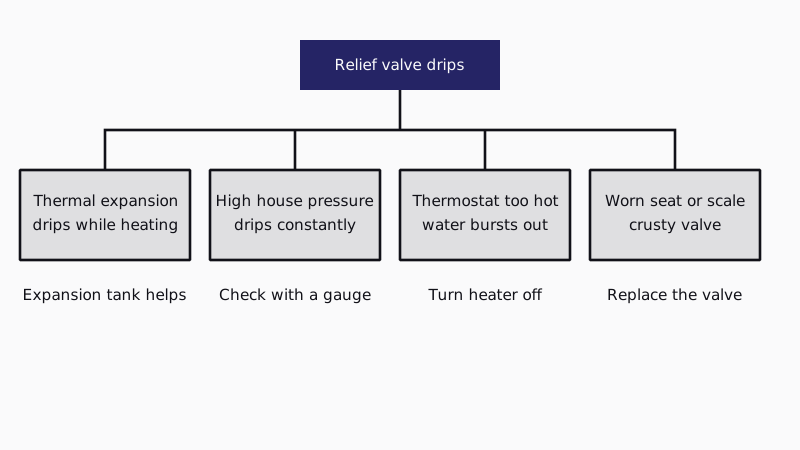
Telling them apart:
- Drips only during heating, then stops: thermal expansion, typical when a check valve or pressure regulator stops expanding water from moving back toward the street. An expansion tank is frequently the answer, though not every code requires one.
- Drips all the time: pressure may exceed 80 psi, the maximum under the California Plumbing Code, section 608.2. Attach a pressure gauge to a hose bib to check. A failing regulator needs to be replaced; adjusting a pressure regulator shows what to inspect.
- Bursts of hot water and a rumbling tank: the temperature is too high, or the thermostat has failed. Turn the heater off and call a plumber.
- Drips and the valve looks crusty: scale or a worn seat. Rancho California Water District's own reports put average hardness around 230 to 240 mg/L, roughly 13 to 14 grains per gallon, in the 2020 to 2023 reports. That is very hard water, which can leave deposits at the valve seat.
Fit a new valve to a system that still has the underlying pressure or expansion fault, and it will begin dripping again within weeks.
How is a relief valve replaced, step by step?
First switch off the power or turn the gas control to pilot, close the cold supply, crack open a hot tap to release pressure, and drain the tank until the level is under the valve. Take off the discharge pipe, unscrew the old valve, apply thread sealant to the new one and screw it in, refit the discharge pipe, and refill the tank with a hot tap open while you check for leaks.
Points that matter:
- Buy a valve with the same pressure and temperature rating and the same thread and length.
- The discharge pipe must slope downward, finish a short distance above the floor or drain, and carry no valve, cap or threads on its end.
- The pipe should not be narrower than the valve's outlet.
- Never reuse a corroded discharge pipe.
- Refill the tank before power returns, as an empty tank damages electric elements when it heats.
On a gas unit, relighting after you turn the gas control off is at your own risk. Should gas be smelled at any point, leave the building and phone SoCalGas at 1-800-427-2200 from outside. Many people hand the whole job to a plumber, which is sensible: the visit is brief, and the plumber can also check line pressure and the expansion setup.
Does swapping a relief valve require a permit?
A valve swap counts as a repair, and permit rules mostly apply to replacing the whole water heater. Installing a new heater generally needs a permit, which comes from the City of Temecula's Building and Safety office within city limits and from Riverside County for unincorporated addresses. If unsure, ask the office first.
State law also wants water heaters braced against earthquakes, so check the straps while a plumber is there. Work in Fallbrook, Rainbow or De Luz is handled by San Diego County Planning and Development Services. The plumber normally takes care of this. See replacing a hot water heater tank if the tank is the real issue.
Would a whole new water heater be the better move?
Sometimes. If the valve drips and the tank is aged, corroded or leaking elsewhere, a fresh valve only delays the inevitable. Check for rust around the base, puddles on the floor, and a tank far past the age when most give out. Then replacing the heater is better value than one more repair.
A valve that kept opening because the tank overheated and scaled up may have damaged the unit as well. Have the plumber examine it all: the tank's condition, the anode, the thermostat setting and the system pressure. For timing, see the page on replacement intervals for water heaters.
Common questions
Should a relief valve ever drip a little?
A drip during heating can be thermal expansion, which is common yet still worth fixing, because it shortens the life of both tank and valve. A drip that never lets up points to excess pressure or a tired valve. Either way, never cap the pipe, and have it looked at before the problem grows.
May I switch off the relief valve or plug its pipe?
No. This valve exists for safety, and blocking it removes the protection against a tank explosion. If it drips and you cannot fix it right away, turn the heater down, close the cold water supply, and phone a plumber. Never plug, cap or tape over the valve or its pipe.
Why is hot water running from the relief valve onto the floor?
The discharge pipe may be missing, cut short or disconnected. It is meant to run down to a safe point. With no pipe, water reaches the floor hot and can scald. Install a proper pipe, or have a plumber correct it, and look into why the valve opened in the first place.
What shows that the water pressure at home is too high?
Thread a pressure gauge onto a hose bib or washing machine valve and read it with no water running. Anything above 80 psi is over the California Plumbing Code maximum. High pressure shortens fixture life and keeps the relief valve busy. A plumber can test it and adjust or replace the regulator.
How do I get a plumber for this?
Use the quote page to say that it is the valve, whether it drips, and how old the heater is. We pass the request to a local plumbing business, and the businesses that take requests pay us a fee. That business sends someone out, who inspects the pressure and expansion setup and quotes the fix.
The rest of our guides start from plumber in Temecula.
Sources used
Updated