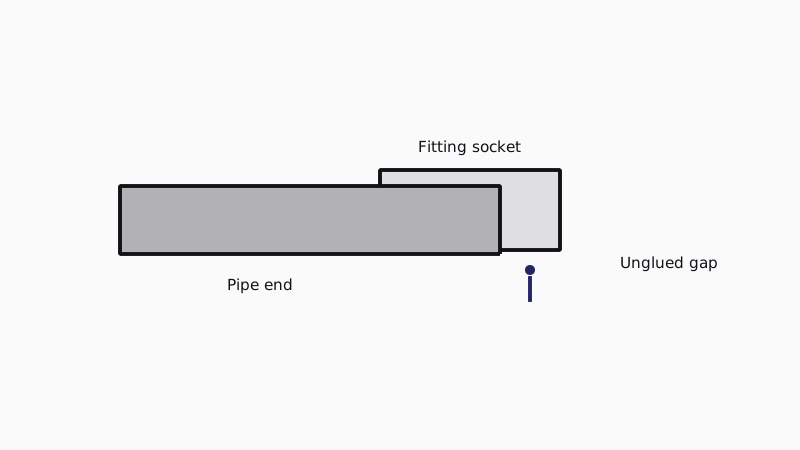
Calling a PVC joint glued is not quite right: it is welded, because primer and cement soften the plastic of the pipe and the fitting so the two fuse. A joint that leaks did not fuse along its whole surface, and smearing more cement on the outside will not repair it. The reliable fix is to cut the joint out and fit new parts. More on the topic is on the leaks and burst pipes page of this site.
Why does a glued PVC joint leak?
Typical causes include a loose fit that left a gap, cement spread too thin, skipped primer, a joint put under pressure before curing, dirt or water on the pipe at gluing time, or an end that was cut crooked. Movement counts too: a joint that was bent or put under strain while setting develops a channel.
Look at the way the leak appears for clues:
- A steady drip or weep at the collar: a partial bond with a thin channel.
- A spray when the water comes on: the joint was pressurized before it cured or never bonded at the bottom of the socket.
- A leak that started months later: pipe movement, ground shift, a freeze crack, water hammer or a threaded fitting that was over-tightened.
- A hairline crack in the fitting itself: common on a threaded adapter where tape and a heavy hand cracked the socket.
Tell the difference between pressure lines and drain lines. A pressurized irrigation or supply line leaks as soon as it is turned on. A drain line only leaks when water flows down it, so the drip may appear at odd times. By EPA figures, the average household loses more than 9,300 gallons a year to leaks, and a constant drip adds to that total.
Can I fix it by adding more glue or using a sealant?
No. Cement works by softening plastic in a close-fitting socket, so a layer painted over a leaking joint does not weld anything. Epoxy putty, repair tape and sealant can slow a leak for a short time and are fine as a stopgap, but they are not a repair, and a joint that was weeping will usually return to leaking under pressure.
Temporary measures are worth knowing about. Close the water off, dry the joint, wrap it with self-fusing tape or press epoxy putty over the weep, and watch it. Treat it as a day or two of cover while you arrange the proper fix. Other options are covered in water pipe leak sealant and fixing a leaking pipe joint without replacing it, which explains when a stopgap is reasonable and when it is not.
How do I replace a leaking PVC joint properly?
Close off and drain the line. Cut out the leaking joint with a hacksaw or PVC cutter, cutting square, then remove burrs and bevel the edges. Dry-fit new pieces with a repair coupling, also called a slip coupling, which slides over the pipe so the pipe itself does not have to move. Prime both surfaces, apply cement and hold the pieces together.
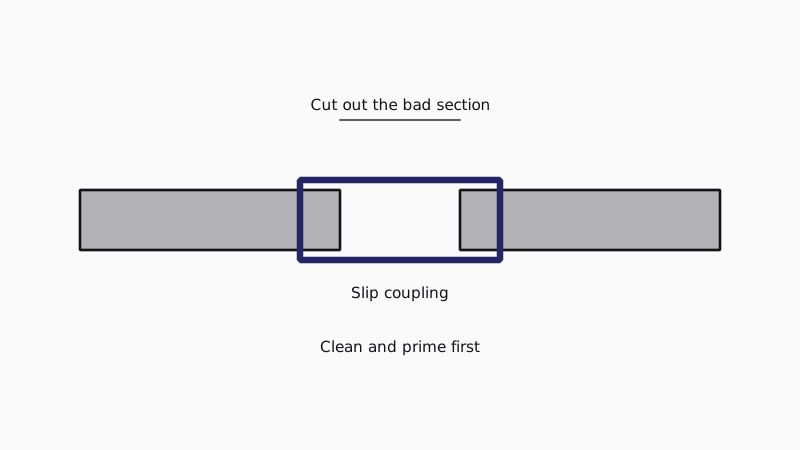
A careful routine:
- Drain and dry. Water on the surface prevents a bond.
- Cut square and clean. A rough cut leaves a gap in the socket.
- Test the fit. The pipe should go a third to halfway into the socket by hand before gluing.
- Prime, then cement. Coat the pipe end and the socket with the right cement for the pipe size and type.
- Push in with a quarter turn and hold it for about half a minute, since the pipe tries to push back out.
- Wipe the bead and leave it. Follow the cement can's set and cure times before the line is pressurized. Colder weather and larger pipe need longer.
Do not run water early to test it. If the can calls for a day, wait a day.
When is this a job for the plumber, not me?
Hire a plumber if the line is a sewer or main drain, if the pipe runs inside a wall or under a slab, if the water cannot be shut off, or if the leak is on a pressurized supply line. A poor repair on a drain can leak waste into a wall. Work of $1,000 or more generally requires a California contractor license.
Many PVC leaks in Temecula homes are on outdoor irrigation lines, pool equipment and well pump piping, where PVC is common, and those are easier to reach. Indoor drains in 1990s and 2000s homes are often plastic as well. When the leak is hard to find, a plumber uses leak detection gear to track it down. For next steps, see stopping leaks from plastic pipe, and for a pipe that has split open, the burst water pipe guide.
How much does fixing a PVC joint cost?
In its January 2025 guide, Fixr puts leaking pipe repair at $150 to $350 and plumbers' hourly rates at $75 to $150. A joint on an exposed outdoor line may land at the low end. One in a finished wall or beneath a slab costs more, since the surface has to be broken open and restored. The quote will separate labor, parts and any access work.
The parts themselves are cheap, so the price is about time and access. A plumber arriving for another job can sometimes fix a small joint for little extra. The home page shows what else we arrange, and the quote page is the place to begin.
Common questions
When can the water go back on?
Check the cement container: set and cure times depend on pipe size, temperature and the pressure the line will carry. Small pipe in warm weather cures faster, and big pipe or cold needs longer. When in doubt, wait a day before a full-pressure test, and open the valve slowly the first time.
Which questions help with a PVC leak quote?
Find out if the leak is one joint or a symptom of something bigger, like high pressure or pipe movement. Ask how the repair will be done, whether the price includes opening and closing a wall, and whether other joints from the same installation need inspection.
Should I be there for the repair?
Yes, or another adult, to show the leak and agree the price, with clear access to the shutoff and the affected line. For an outdoor line, open the gate or side yard. Mention if others in the house will lose water meanwhile.
Why does my PVC joint leak right after tightening a threaded fitting?
Over-tightening cracks the socket on a threaded adapter, and wrapping too much tape can split the female side. Tightening by hand and then about one more turn is usually enough. If the fitting has cracked, it must be replaced, and a larger wrench will only make it worse.
Updated