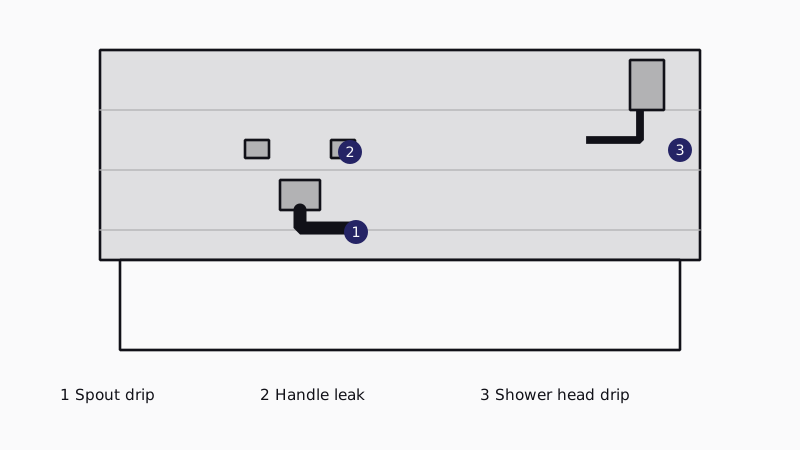
A dripping tub faucet is cured by closing the water supply, removing the handle and replacing the worn part under it: a cartridge in a single-handle faucet, or a rubber washer and seat in a two-handle one. Basic tools and roughly an hour are usually enough. If the leak proves to be inside the wall, a plumber takes over, and the garbage disposal and faucet repair page is where that help starts.
Why does a bathtub faucet leak?
Most tub faucet leaks begin when a seal wears out. A single-handle faucet has a cartridge with rubber rings that harden or tear. A two-handle faucet presses a washer onto a seat, so the washer flattens and the seat grows rough. Hard water speeds up the damage by leaving scale on moving parts, which is why drips often start in areas with the hardest water.
Rancho California Water District's own reports put average hardness around 230 to 240 mg/L, roughly 13 to 14 grains per gallon, in the 2020 to 2023 reports. That is very hard water. Scale on a cartridge or inside a diverter is common in a Temecula bathroom, and a vinegar soak can bring back a part that is not yet damaged. Your current Consumer Confidence Report is at ranchowater.com.
Where the water shows up tells you what to inspect. A spout that drips with the faucet closed points to the cartridge, washer or seat. Dripping from the shower head after a bath suggests the diverter or that same valve. Water pooling around the handle means the packing or an O-ring has failed. A stain on the ceiling underneath, or behind the wall, signals a pipe or joint problem for a plumber.
How can I fix a Moen bathroom faucet that leaks?
Many single-handle Moen faucets use a cartridge that can be swapped. Turn the water off, pop off the handle cap, remove the screw and handle, then take out the retaining clip or nut. Grip the cartridge with pliers or a puller and draw it directly outward. Seat the matching new cartridge facing the same way and refit the clip. Buy according to model number, so look that up beforehand.
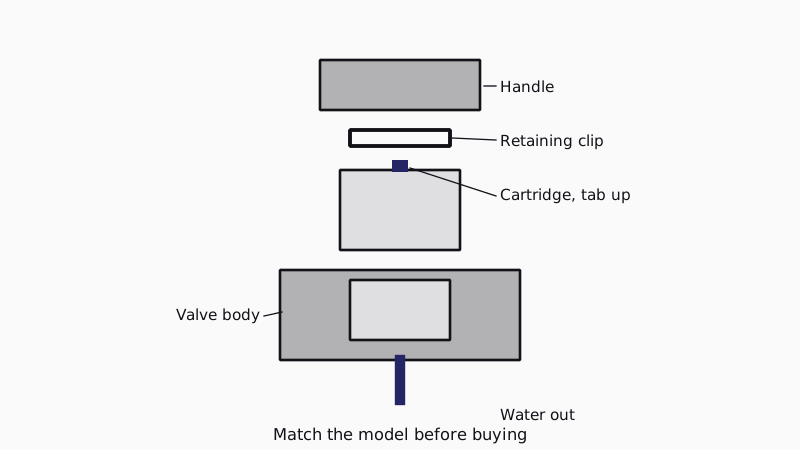
Moen uses several cartridge styles, so do not presume the part is identical across models, and the old one may not match what the store lists. Look for a number stamped on the faucet or on the cartridge, and read Moen's own instructions for your model. A new cartridge that still drips points to a worn valve body, which is a bigger repair.
A bathroom sink faucet follows the same logic, and the page on repairing a dripping faucet handles both kitchen and bathroom sinks. Small drips add up. Per the EPA, an average household can waste over 9,300 gallons a year through leaks, so an hour of work is worthwhile. A separate page explains what a dripping faucet does to the bill.
How do I repair a dripping two-handle tub faucet?
Lever the cap off the handle, remove the screw, draw the handle off, undo the packing nut or bonnet and pull out the stem. Fit a fresh rubber washer at the bottom and a new O-ring on the stem. A pitted brass seat in the valve should be smoothed with a seat dresser or replaced. Reassemble in reverse, grease the threads and test.
Work on one side at a time so you can compare. If only the hot side drips, new parts are needed on that side alone, although many plumbers change both while the faucet is apart. Slow, steady pressure can loosen a stuck stem; one that stays put calls for a puller tool or a plumber. More detail is in the guides on the two-handle bathroom faucet and two-handle shower.
What if the pipe under the kitchen sink is leaking?
Pin down the source first: dry everything, run the tap and then the drain, and watch closely. A slip nut on the trap that drips often needs only a hand-tightening and a new washer. A cracked trap or tailpiece has to be replaced, and a braided supply line that drips needs a new one. Before starting, put a bucket underneath and close the stop valves.
A sequence helps. Shut both stop valves beneath the sink and position the bucket. Undo the slip nuts on the P-trap, remove it and check the washers and pipe. Replace any warped washer, cracked piece or worn nut. Put it back together hand-tight and run water. If the stops are stuck or leaking, stop and call a plumber. The trap, supply line and disposal drain are covered in repairing the pipe beneath your sink.
Sealant or tape on a cracked drain is never a permanent repair. Keep drain cleaner out of any pipe that is leaking. A leak on a copper or plastic supply pipe inside the cabinet calls for closing the water and phoning a plumber, as the fittings may need soldering or special tools.
At what point does a leaky tub faucet need a plumber?
Phone one when the leak is within a wall or ceiling, a cartridge or stem refuses to come out, the valve body has cracked, the shutoffs fail to close, or the faulty part is impossible to identify. Damp drywall or a stain under the bathroom is more urgent, as a concealed pipe leak can damage the structure and feed mold.
To get a plumber, request a quote, say which faucet type you have and whether the shutoffs work. Faucet prices are in the guide on installing a faucet. For a leak inside a shower wall, read a plumber for a shower leak.
Which tools do I need, and where do I stop the water?
Gather screwdrivers, an adjustable wrench, pliers, hex keys, a pick or small flat tool, rags, replacement parts and plumber's grease. Stuff a rag into the drain so no screw can drop in. If separate stop valves serve the tub, close them; if not, close the main shutoff and open the tub tap to drain the line.
Plenty of older tubs lack individual stops. Houses built from the 1960s to the 1990s in Rancho California, and older buildings in Old Town, are the most likely to be missing them. When the main shutoff will not turn or will not hold, do not force it. Call a plumber, since a valve that breaks costs far more than the repair.
Take photos before disassembly and arrange the parts in sequence on a towel. Carry the old cartridge or washer to the store and match it there, since sizes and stems vary.
Common questions
How much time does a tub faucet repair take?
Budget about an hour for a cartridge or washer swap, somewhat more if the old part is stuck or the right match takes searching. A plumber often finishes sooner because tools and parts are already in the van. Scale that has seized the stem can extend the work. Leave time to watch for drips after reassembly.
What should I confirm with a plumber before hiring one for a faucet leak?
Confirm whether the quote covers the call fee, the cartridge or washers and the labor, whether the valve seat and shutoffs get inspected, and what happens if the wall must be opened. Settle the price in advance. Mention small extras, such as a loose handle, so one visit deals with everything.
Must someone be home for a faucet repair?
Yes, or have an adult you trust there. Access to the tub, the shutoff and sometimes an access panel is something the plumber requires, and the supply will be cut for a while. Empty the bathroom, set toiletries aside and agree the price first. If you cannot attend, ask for photos of the finished work.
Is replacing the faucet cheaper than repairing it?
With a cheap faucet in poor shape, replacement can cost about as much as repair. With a good faucet that only has a failed cartridge, repair costs less. Replacement makes sense when the valve body is damaged or parts are no longer sold for an older model. Ask the plumber to set the two options side by side on one quote.
The rest of our guides start from the plumber guide for Temecula.
Updated