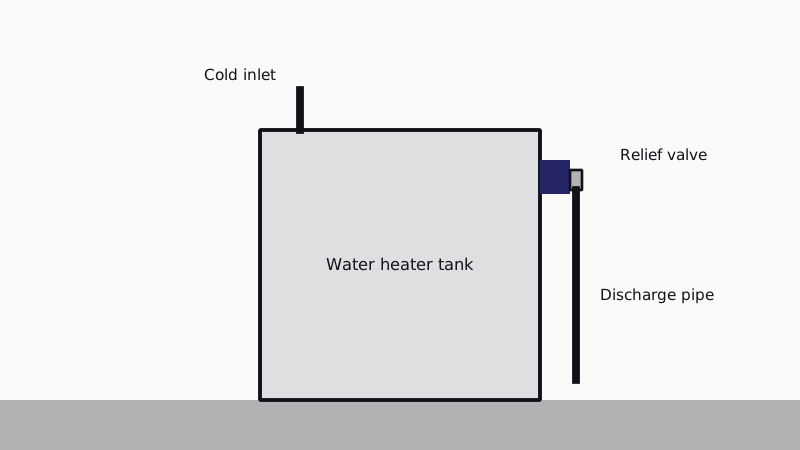
Fitted to the top or side of a tank heater, the release valve, whose proper name is the T&P relief valve (temperature and pressure), opens when the tank overheats or pressure builds too high. Dripping is a warning sign. Swap the valve when it is old or leaking, and fix the underlying cause as well. See water heater repair for the wider topic, or submit a request, which we pass to a local plumbing business.
What is the relief valve for, exactly?
This spring-loaded safety valve guards the tank. If pressure rises beyond its rating, or the water gets too hot, it pops open and sends water down a pipe so the tank cannot rupture. InspectApedia gives the standard opening pressure on home heaters as usually 150 psi, with a maximum temperature rating usually 210 degrees Fahrenheit.
That makes the valve the last line of defense, which is why nobody should cap it, plug it or take its pipe away. A discharge tube should run from the valve downward and end about six inches above the floor or at a drain. Without that pipe, a valve that opens sprays scalding water at whoever stands nearby. A plumber checks the tube along with the valve.
Why is the valve dripping or leaking?
When the relief valve drips, the cause is usually excess tank pressure, overheated water, a worn valve seat or mineral debris lodged in the seat. Scale builds up there in hard water, and Rancho Water reports average hardness around 230 to 240 mg/L in Temecula, so mineral crust is a frequent culprit.
Here are the causes worth separating:
- High supply pressure. Per InspectApedia, leaks can begin when pressure in the building goes beyond roughly 70 psi, most often because the regulator at the main has failed. See adjusting a pressure regulator.
- Thermal expansion. If a check valve or regulator closes off the house plumbing, water that expands as it heats has nowhere to go and can open the valve with each cycle. An expansion tank is the usual cure.
- Overheating. A thermostat set too high or a failing control can push the water toward the valve's limit.
- A tired valve. Old valves can drip after the test lever is lifted, if a bit of gasket breaks loose.
- Water hammer. The Wikipedia entry on water hammer notes pressure spikes from quick-closing valves, and spikes can pop a relief valve. Why pipes bang covers it.
How do I test the valve, and is it safe to?
Run the test only when the discharge pipe is in place and clear, and keep your face and hands out of its path. Lift the lever briefly, and water should flow into the drain or onto the floor, then stop when you release it. If it keeps trickling, the valve is done. If nothing comes out, it may be stuck, and you should not rely on it.
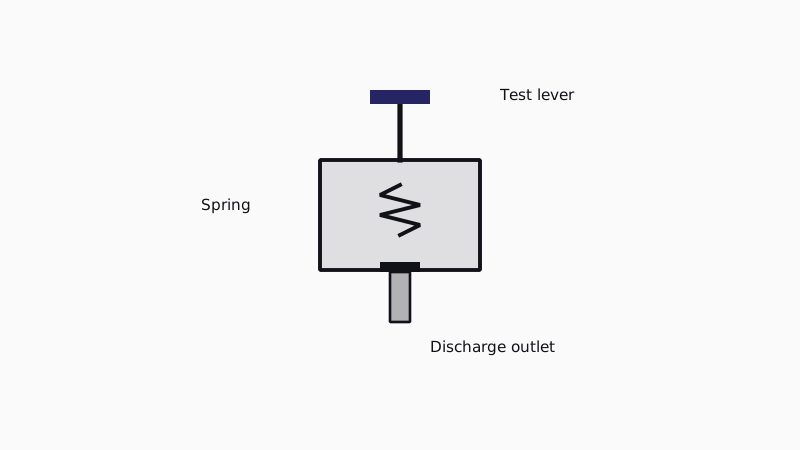
Be careful: the water that comes out is hot. Keep children and pets away, and never put your hand under the pipe. Some old valves start leaking after a test because a piece of brittle gasket breaks loose, so a test can turn a quiet valve into a dripping one. That is a reason to book a plumber rather than test it repeatedly.
At what point is a new valve needed, and who fits it?
Replace it when it drips nonstop, when mineral deposits clog it, or when it has opened from over-temperature even once, because a valve that has truly opened tends to leak afterward. The part costs little, but the job means draining some water from the tank and working beside gas or electric controls, so letting a plumber do it is safer.
A replacement must match the heater: the same pressure rating, temperature rating and thread size, and a capacity suitable for the heater's input. A wrong valve defeats the purpose. Never put a shutoff valve between the relief valve and the tank, and keep insulation off the valve, since it hides leaks and can interfere with sensing. Leave space above the valve for removal.
A valve swap counts as a repair, but a whole new heater is bigger: inside Temecula, a permit is generally required for replacing the whole water heater, so ask the plumber or the City of Temecula Building and Safety office what applies at your address. Outside city limits the county permit office handles it.
What should I check while the valve is being replaced?
Use the visit to chase down the cause. The plumber can measure supply pressure with a gauge, look for an expansion tank, examine the discharge pipe and inspect the tank for rust and scale. A tank that is old and corroded is better replaced than patched, as covered in heater replacement intervals.
If you own a tankless heater, relief valves still matter on the system, and the repair rules are similar. The tank versus tankless comparison explains how the two differ in maintenance.
Our home page lists the remaining water heater jobs we handle. Homes on wells in Temecula Wine Country or Aguanga can see pressure swing as the well pump cycles, so tell the plumber when yours runs on a well.
Common questions
How long will the valve swap take?
For a plumber, swapping the valve commonly takes under an hour after the heater is off, cooled and partly drained. Allow somewhat longer when the valve sits in a tight spot or the old one has seized on corroded fittings. The heater is usually back in service the same day, once the tank has refilled.
Which questions should I raise before picking a plumber for it?
Find out if the new valve will match your heater's pressure and temperature rating, if the discharge pipe will be checked or fixed, and if pressure will be tested and an expansion tank looked for. Settle the price ahead of the work, with parts and labor listed.
Must an adult be home for the visit?
Yes, someone should admit the plumber and approve the price, because the water and the heater will both be off for a time. Keep an unobstructed route to the heater and the floor drain too. A closet or garage heater should be cleared of storage so that nothing blocks the work.
Can I replace the valve myself?
Some people do. It is a threaded part and a discharge pipe. But hot tanks, gas or electricity and a safety device are all involved, so a mistake can be dangerous. If you try, switch off the gas or power, let the water cool and do not cut corners on the discharge pipe. If unsure, call a plumber.
Updated