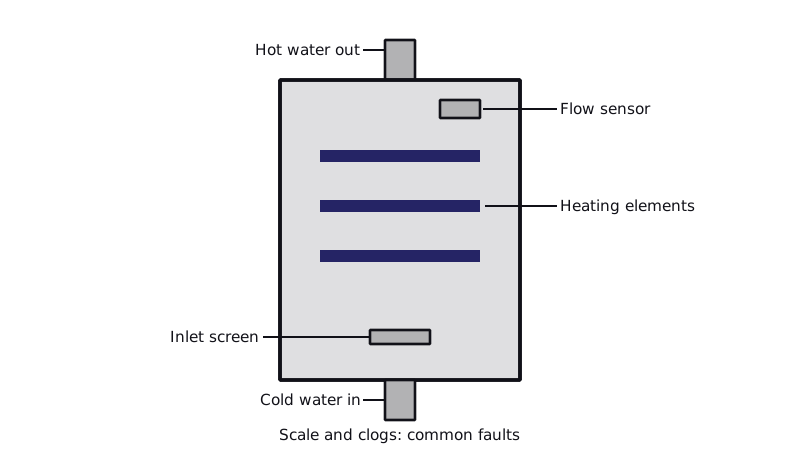
An electric tankless heater warms water as it passes through, using large heating elements on heavy circuits. When it falters, the cause is usually low flow, mineral scale on the elements, a tripped breaker or a clogged inlet screen. Your manual lists the exact fault codes for your model. For wider coverage, head to the page on water heater repairs; a comparison of the two unit types sits at tank or tankless.
Why does my electric tankless heater only give lukewarm water?
Lukewarm water usually means the unit cannot heat the flow it is getting. Common reasons are too many taps open at once, a clogged aerator or inlet screen cutting flow, scaled heating elements, or a breaker that has tripped on one of several circuits. A cross-connection in a single-handle faucet can also feed cold into the hot line.
Check from the simplest to the hardest:
- Test a single tap. If one tap on its own is warm and two are lukewarm, you have hit the unit's capacity, not a fault. Tankless heaters have a flow limit, which is why big households sometimes add a second unit.
- Look at the display. Many units show a code or a status light. Match it to the manual and do not guess.
- Check the breakers. Electric tankless units commonly use several large breakers, and one tripped breaker cuts heating power. Reset it a single time; should it trip again, stop and call an electrician or a plumber.
- Clean the aerators. A clogged faucet aerator cuts flow below the point where the unit fires.
- Check for a cross-connection. A failed check valve or worn single-lever cartridge can blend hot and cold. If only one fixture shows the problem, that fixture is to blame.
Water that is hot at one tap and cold at another is a plumbing fault, not a heater fault. Those causes are covered in the checklist for a house with no hot water.
Does hard water damage an electric tankless heater?
Yes. Scale coats heating elements and the flow path, which reduces heat transfer and flow, makes the unit work harder and trips safety limits. Rancho California Water District's 2020 to 2023 reports put average hardness around 230 to 240 mg/L, about 13 to 14 grains per gallon, a level classed as very hard.
Scale shows up as a gradual temperature drop, hot water that takes longer to arrive, rumbling or hissing, and error codes that clear after a flush. The cure is a descale flush using the unit's service valves, pumping descaling solution through with a small pump as the maker directs. How often depends on the water, and in very hard water more often than the manual's baseline suggests.
Two ways to cut the problem down: a softener or scale-control device ahead of the heater, which the softener installation page explains, and a flush schedule you actually keep. If your water comes from a private well, which is common in Wine Country, De Luz and Aguanga, hardness varies by well and a test tells you what you are dealing with.
What can I safely check myself on an electric tankless unit?
You can safely check the display, the breakers, the faucet aerators, the inlet screen and the temperature setting, provided the power is switched off at the breaker before any cover comes off. Do not open sealed electrical compartments or touch elements while the power is on. This is a high-load electrical appliance.
Most owners do well with this order of steps:
- Switch the breakers off before touching the unit. Confirm there is no power, ideally with a tester.
- Shut the water to the unit and let pressure off at a tap.
- Clean the inlet screen filter, if your model has one, and check it for debris. Sand from a disturbed line is a common cause of blockages.
- Check that the temperature setting is where you left it. Power outages can reset a setting.
- Restore the water first and purge air by running hot taps for a minute, then switch power on. Heating air-filled elements without water can damage them.
Skipping the purge is a classic error. Elements that fire without water around them can fail within seconds. Always refill the unit and let the taps run before turning the power back on.
When does an electric tankless unit need a pro?
Call for help when a breaker keeps tripping, when the display throws a code that survives a flush, when you see scorching, a burning smell or water around the unit, or when you suspect a failed element, sensor or control board. Wiring and circuit work is electrical work, and some parts are warranty-sensitive.
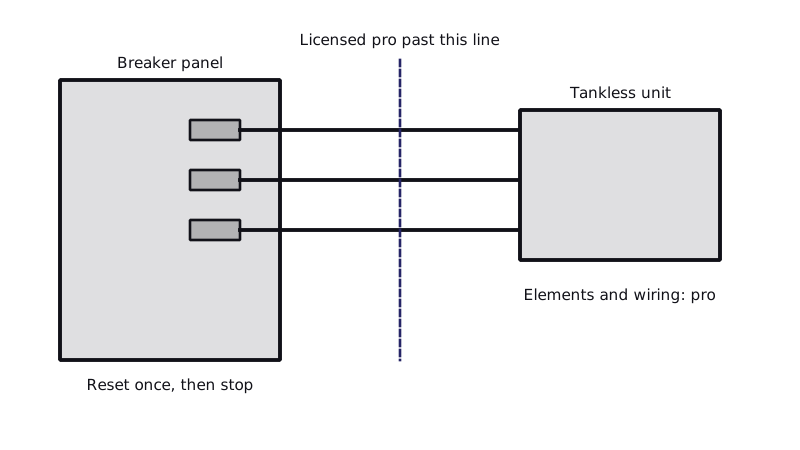
Electrical rules apply. Under California rules a contractor license is needed whenever a job requires a permit, and changing a circuit, a breaker size or a service panel for a tankless unit is generally permitted work. A repair with like-for-like parts is a different matter, but the manufacturer may not honor a warranty if an unqualified person opens the unit, so read the warranty before you start. Work out which office handles your job: Temecula Building and Safety inside the city, the county for outlying parcels.
If you cannot tell whether the heater or the water supply is at fault, the plumber can test flow and pressure. When you fill in the quote page, mention the code you saw, how old the unit is, and whether hot water fails at a single tap or throughout the house.
Is it worth repairing, or should I replace the unit?
Repair when the fault is a part: an element, a sensor, a screen or a flush. Think about replacing if the unit is old, scale damage keeps coming back, or repairs approach what a new unit costs. The Department of Energy credits tankless units with lifespans beyond 20 years, so a healthy unit is often worth repairing.
Look at the pattern. A heater that has had one fault in many years deserves a repair. A heater that breaks down each season in very hard, untreated water may break down again after a repair. Parts for older models may be scarce, so ask whoever quotes the job whether they are in stock.
If a tankless unit has been a poor fit for how your household uses hot water, replacement might mean a different kind of heater altogether. For a side-by-side look, use the tank versus tankless page.
Common questions
What does an error code on a Rheem tankless heater mean?
The code points to a sensor, flow, temperature or power fault, and your model's manual decodes it. Write down the code, power the unit off and on once and check whether it comes back. If it persists after you check flow and scale, a technician should read it.
How often should I flush an electric tankless heater?
The manual gives the baseline schedule, while very hard water means flushing more often than that minimum. In Temecula's very hard water, many owners flush at least yearly. If you notice reduced hot water flow, longer waits or a rumbling sound from the unit, flush it sooner than planned.
Can an electric tankless heater trip my breaker?
Yes. The units draw a large electrical load, and a failed element, a wiring fault or an undersized breaker can trip one. Reset it a single time. Should it trip again, leave the unit off and call for help, because repeated resets can overheat the wiring.
Does repairing a tankless heater require a permit?
Swapping in matching parts is typically not permit work, whereas replacing the entire unit or altering its circuits generally is. Rules differ by location, so ask the local building department responsible for your address before starting, and keep the answer in case anyone asks later.
Is descaling a DIY task?
Frequently, if the unit has service valves and you follow the maker's steps. You need the right descaling solution, a small pump and a pair of hoses. Keep the power off the whole time you work, and rinse the unit well before going back to normal use.
The rest of our guides start from plumber across Temecula.
Updated