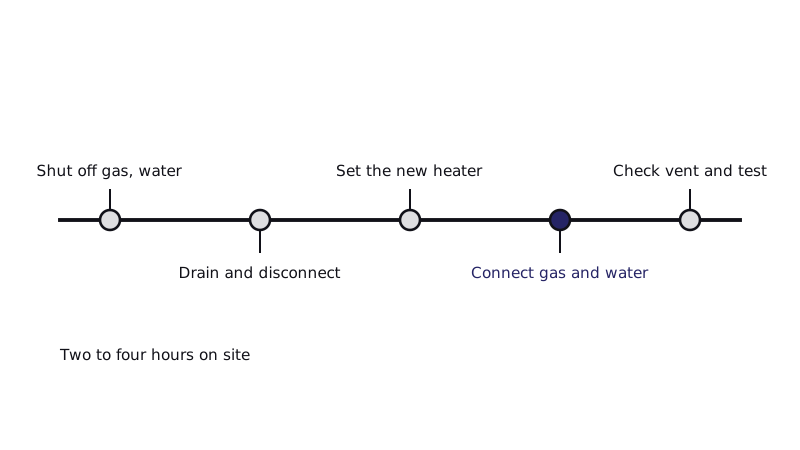
One published cost guide gives about $600 to $1,200 for labor on a standard gas tank water heater, over two to four hours. That is the plumber's time, not the heater. The complete picture, with the unit and permit, lives on our water heater service page, while this page stays on the labor line of the quote.
How much is the labor to swap a gas water heater?
In the guide we read, the labor share of a gas heater swap is typically $600 to $1,200, covering roughly two to four hours of work. Some plumbers charge by the hour, others a flat price for the visit. Add materials, the permit and the heater itself to reach the all-in figure, which the guide puts at about $1,300 to $2,300 for a 40 gallon gas unit.
Labor looks steep next to the cost of a tank, but the task is more than unbolting one box and bolting on another. Gas and water are shut off first, then the old tank is emptied, detached and carried out. The new one is set and leveled, fresh water connections are made, and gas is hooked up with a new flexible connector and shutoff where needed. The plumber then inspects the vent, leak-tests every joint, lights the pilot or burner, and confirms the vent draws properly.
A gas leak or faulty vent is a safety hazard, so part of that time goes to checking and testing, and those checks belong to what the fee covers.
Is water heater labor billed hourly or as a flat fee?
Both are common. One guide averages plumbers' hourly rates at about $90 and another at $110 to $125, and the latter also puts West Coast pricing at $130 to $180. Typically a $50 to $100 service call fee comes on top. Many plumbers set a flat price for a standard swap, because the job is predictable.
A flat price is easier to compare. An hourly quote needs an estimate of time, and a cap or "not to exceed" figure. When a plumber quotes hourly, ask how many hours they expect, what happens if it runs over, and whether travel time is billed. Remember too that evening, weekend or holiday calls commonly add 50 to 100 percent to the rate.
Do not let a low hourly rate decide for you. Six hours at $90 an hour costs more than three hours at $140. The right comparison is the total for the same scope.
Which extras raise the labor on a gas heater?
All from the same guide: moving the heater adds about $300 to $600, difficult access adds about $150 to $350, and switching fuel adds $500 to $1,200. On a gas unit the vent, the gas connector and the shutoff are the usual extras, along with an expansion tank, which runs $100 to $350 installed.
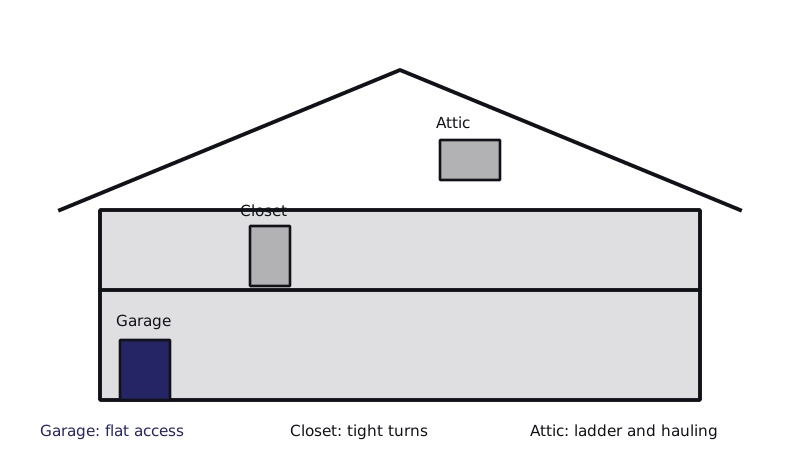
Here is how those extras show up in a typical Temecula house.
- Garage or side-yard unit: easiest. Access is flat and the vent runs through the roof or wall as before.
- Closet or attic unit: harder. Hauling a full tank and a heavy new unit through tight space takes time, and an attic leak pan and drain need to be right.
- Older home with an old vent: the vent may need replacing. In Rancho California tract homes of the 1970s to 1990s, you may find old connectors and shutoffs worth replacing while the line is open.
- Rural lot on propane: a propane unit is a different model, so a swap between propane and natural gas is a bigger job.
Seismic strapping is part of the job in California. Under state law (Health and Safety Code 19211), earthquake bracing, anchoring or strapping is required for new and replacement water heaters, so ask that it be listed.
Does the permit add to the labor cost?
Swapping a water heater generally calls for a permit, with the guide listing the fee at roughly $75 to $200, normally included in the quote. Within the City of Temecula, Building and Safety handles permits at 41000 Main Street, 951-694-6476, with the counter open weekdays 8 a.m. to 5 p.m., closed on holidays. An inspection normally follows the install.
Addresses beyond city limits, including parts of Wine Country, French Valley, Winchester and Aguanga, get their permits from Riverside County Building and Safety. For the San Diego County part of De Luz, as well as Fallbrook and Rainbow, the office is San Diego County Planning and Development Services. Verify the parcel first, as it is not always obvious which side of a boundary a property sits on.
A contractor license is required in California for work that needs a permit and for work of $1,000 or more in labor plus materials, so whoever does the job must hold one. A gas connection is a poor DIY choice. If you smell gas, leave the building, then call SoCalGas on 1-800-427-2200 from outside, and use 911 if you are in danger.
Common questions
How many hours does a gas water heater swap take?
The guide we read lists about two to four hours for a standard like-for-like swap. Relocating the unit, changing the vent, upsizing the gas line or a hard-to-reach spot can push the job to most of a day. Hot water is off during the work, so plan showers around it. The plumber can name a likely window with the quote.
Which questions matter before hiring a gas water heater installer?
Find out if the quote is flat or hourly, what it covers, who obtains the permit, whether the old heater is hauled off, and whether code items such as straps and an expansion tank are itemized. Ask too what happens if the vent or gas line needs work. Have the answers in writing.
Should I stay home during the replacement?
Plan to be present when the work starts and again when it finishes. The plumber must reach the heater and the shutoffs, and you will want to inspect the work and approve it. If you have to be out, a trusted adult may let the plumber in instead. Say so when booking so it is planned.
Is labor cheaper if I buy the heater myself?
Not always. Some plumbers will install a heater you bought, but many prefer to supply it so they can stand behind the whole job, and labor does not usually drop. A wrong size or fuel type can cost you a return trip. Ask before you buy, and get the heater's model and size confirmed.
This guide is one of many on plumber in Temecula.
Updated